
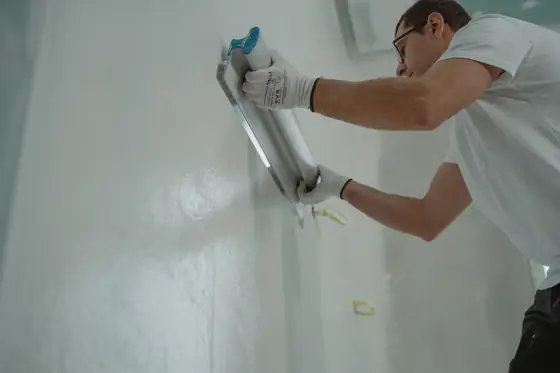
Plastering in a village built mostly after 1983
With around 82% of properties from 1983 onwards, the typical Papworth wall is plasterboard with a thin skim. As a newer house settles, cracks open along board joints and where walls meet ceilings. Hairlines are a decorator's job, while longer or recurring cracks may need cutting out and a fresh skim.
Re-skimming is also common after wallpaper comes off badly, when the paper face of the plasterboard tears and leaves a rough, patchy surface. Lewis, our plasterer, skims it flat so our decorators can carry straight on.
Where a plasterer is needed in older Papworth homes
Papworth still has a small group of earlier houses, including about 70 from before 1900 and six listed buildings. Older walls may have lath and plaster or lime, and Graham will judge at the survey whether careful filling and lining paper will do or a skim is needed.
The textured ceilings that do turn up, mostly in the 1950s to 1970s homes, can be skimmed smooth. Our plastering page and the Artex case study show how.
Papworth Everard at a glance
- 20 milesby road from our Landbeach base, about 25 minutesOSRM routing
- 5%were built 1945 to 1964VOA Council Tax stock
- 3%were built 1965 to 1982VOA Council Tax stock
- 4%of properties were built before 1919VOA Council Tax stock
- 1,530householdsCensus 2021
- 6%date from 1919 to 1939VOA Council Tax stock
How we approach plastering
We sheet the room, take down fittings and prepare the surface so the skim bonds. Lewis skims, the plaster dries fully, and our decorators sand dust-free, apply a mist coat to reveal any small flaws, fill those and then paint. If cracks keep returning, we'll tell you they may point to movement or a leak rather than simply filling them again. The full method, products and FAQs are on our plastering page.