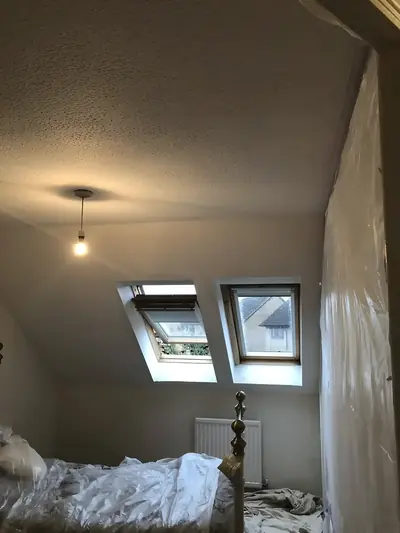
Artex in Swavesey's 1960s and 1970s houses
Skimming over a textured ceiling gives a flat modern surface without taking the ceiling down. The room is sheeted, fittings come down, and the surface is prepared so the new plaster bonds. Lewis, our plasterer, or the master plasterer we work with carries out the skim, and our decorators follow on once it has dried.
On one whole-house renovation, two plasterers skimmed old Artex ceilings while our decorators stripped and prepared walls in other rooms, which kept the programme short.
Plastering in Swavesey's older cottages
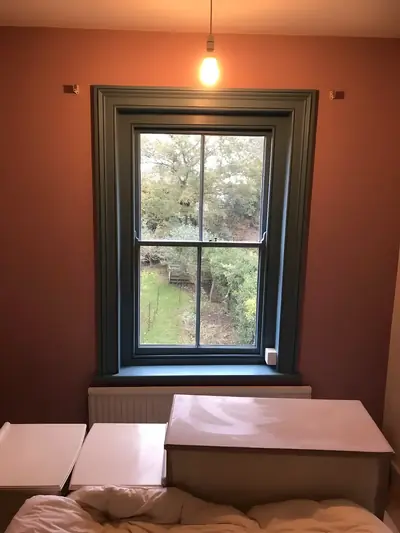
Council Tax records list roughly 160 homes in the parish from before 1919. Older walls can hide lath and plaster or patched repairs that only show when paper is stripped. In a Cambridge bedroom, stripping revealed tired lath and plaster, so our plasterer skimmed it before we decorated, as the bedroom strip and skim case study shows.
Not every old wall needs skimming. Sometimes filling and lining paper are the better answer, and Graham will say which at the visit.
Textured walls and ceilings, hollow-sounding boards and lime in Swavesey homes
Council Tax records date 83.1% of Swavesey's properties to before 2000, including about 150 from 1965-1972 and 120 from 1973-1982. That matters for any textured coating: the HSE says Artex and similar finishes in buildings built or refurbished before 2000 may contain asbestos, so a sample is tested before the ceiling or wall is sanded, scraped or drilled. Our plasterers skim only once the result is clear, and a positive test goes to a specialist.
Textured finishes weren't always confined to ceilings. A hall, stairwell or chimney breast may have been given the same treatment, and those walls are skimmed in the same way once they're tested, with safe access set up over the stairs. Graham will look round the whole house at the visit, not just the room you've asked about.
In the houses from 1983 to 1999, a wall that sounds hollow when tapped isn't necessarily a fault: plasterboard was often fixed to the blockwork with dabs of adhesive, leaving a gap behind it. Cracks along the board joints are filled or taped and skimmed, and fixings for heavy items need the right plugs for a hollow wall.
Figures from Valuation Office Agency Council Tax stock by build period. Contains public sector information licensed under the Open Government Licence v3.0.
Swavesey at a glance
- 8 milesfrom our Landbeach base in a straight line, about 20 minutes by roadOSRM routing
- 6%were built 1945 to 1964VOA Council Tax stock
- 23%were built 1965 to 1982VOA Council Tax stock
- 14%of properties were built before 1919VOA Council Tax stock
- 1,167householdsCensus 2021
- 5%date from 1919 to 1939VOA Council Tax stock
Sources: Census 2021 for Swavesey parish (ONS); Council Tax: stock of properties, 2026; road distance by OSRM.
Listed buildings: check before plastering
Old plaster is part of a listed building, so in a listed Swavesey house, replacing lime plaster or taking down an old ceiling may count as work affecting its character and need listed building consent. Ask Greater Cambridge Shared Planning before the plasterer is booked; the council's Listed Buildings SPD and its leaflet explain its approach.
Council guidance on listed buildings · Listed Buildings SPD (PDF) · Listed buildings leaflet (PDF)
How we approach plastering
In a Swavesey room, any test on a textured coating has to be clear before the plasterer starts. The room is cleared or sheeted, floors protected, and light fittings, smoke alarms and anything fixed to the walls taken down. Loose patches and cracked joints are cut back and made good, and the skim goes on. Once it has dried to an even colour it's sanded lightly with Mirka dust-free sanders, sealed with a thinned mist coat, filled where needed and finished with two coats. Each step and the products we use are explained on our plastering page, with answers to common questions.