
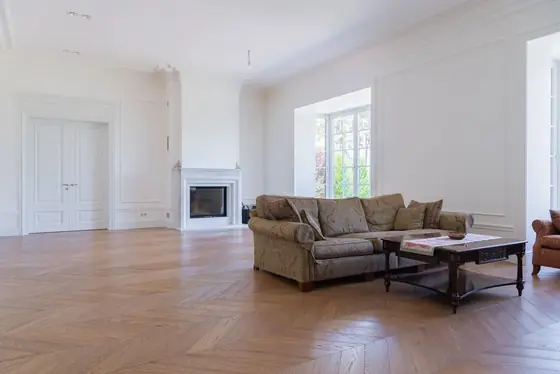
Boards in Swavesey's period houses
Old pine boards tend to have gaps, patches of later timber and stains from past rugs. Most of that blends in once the floor is sanded and oiled. Chris, the wooden floor specialist we work with, checks each floor first and points out anything that won't, such as a badly split board.
Interwar homes make up around 5% of the village and may also have solid boards. Newer houses more often have engineered or laminate floors, which Chris will tell you honestly can't be sanded in the same way.
Floor sanding in Swavesey: the process
Rocking boards are fixed down first and any nail heads are punched below the timber. Chris runs the belt sander through progressively finer grits, then follows the walls with an edger. Gaps between boards take a paste of the floor's own dust and Induro Morrells Mix & Fill, so the filler matches, and a Mirka dust-free sander leaves the surface ready for Osmo.
In Haddenham, Chris finished a dining and living room in Osmo Polyx tint oil in Gold, with flecks of 24-carat gold. Our floor sanding page has the full story.
Swavesey at a glance
- 14 milesby road from our Landbeach base, about 20 minutesOSRM routing
- 14%of properties were built before 1919VOA Council Tax stock
- 5%date from 1919 to 1939VOA Council Tax stock
- 13%are terracedCensus 2021
- 28listed buildingsHistoric England
- 1,167householdsCensus 2021
How we approach floor sanding
The room is emptied and doorways sealed. Chris secures the boards, belt sands and edge sands, fills gaps with sawdust and Mix & Fill, then smooths with a Mirka sander. Clear or tinted Osmo Polyx oil goes on in thin coats with drying time between, and our decorators touch in any skirting scuffs afterwards. The full method, products and FAQs are on our floor sanding page.