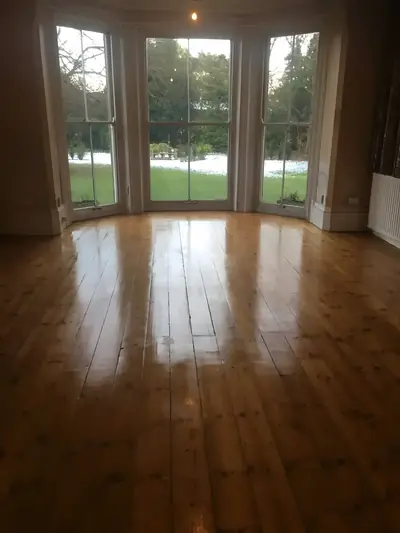
What's under the carpet in a 1970s or 1980s house
Most homes in and around Bar Hill were built between 1965 and 1999. Ground floors from that period are often concrete, and upstairs floors vary. Some owners have since laid solid hardwood, which sands well, while engineered boards can only be sanded a limited number of times and laminate not at all.
Chris, our wooden floor specialist, looks at the floor before anything is quoted and will tell you plainly if sanding isn't the right answer.
When a Bar Hill floor does suit sanding
For a solid timber floor, Chris works through the grades with a belt sander and an edging sander, fills gaps with the floor's own sawdust mixed with Induro Morrells Mix & Fill, then smooths it with a Mirka dust-free sander. He finished a Haddenham floor in Osmo Polyx tint oil in Gold, shown in the floor restoration case study.
In a village where 69% of homes have three or more bedrooms, the jobs we'd expect are a living room, a dining room or a landing rather than a whole house. Booking floors with interior decorating means the skirtings can be touched in once the sanding is done.
Why sanded floorboards are less common around Bar Hill, and who still benefits
Valuation Office figures for the wider statistical area around Bar Hill put just 1.3% of properties in the 1919-1939 period and 4.4% before 1919, where England's figures are 14.8% and 20.0%. Original pine floorboards belong mostly to those older homes, so the classic sanding job is uncommon around the village.
If you're not sure what you have, lift a carpet corner in a bedroom and on the landing. Separate planks with visible grain may be worth a look from Chris; large flat sheets with a speckled, chip-like surface are chipboard, which can't be sanded at all.
Sanding still suits some homes around Bar Hill: the few older properties, and any house where a solid hardwood or parquet floor has gone down since it was built. Parquet has its own checks, including testing old black bitumen adhesive before loose blocks are lifted, which our parquet restoration page explains.
Figures from Valuation Office Agency Council Tax stock by build period; Historic England's National Heritage List. Contains public sector information licensed under the Open Government Licence v3.0. © Crown Copyright 2026. Contains Ordnance Survey data © Crown copyright and database right 2026. Released under OGL.
Bar Hill at a glance
- 7 milesfrom our Landbeach base in a straight line, about 14 minutes by roadOSRM routing
- 4%of properties were built before 1919 (Bar Hill and the surrounding area)VOA Council Tax stock
- 1%date from 1919 to 1939 (Bar Hill and the surrounding area)VOA Council Tax stock
- 28%are terracedCensus 2021
- 1,739householdsCensus 2021
Sources: Census 2021 for Bar Hill parish (ONS); Council Tax: stock of properties, 2026, for the statistical areas covering Bar Hill and the surrounding area; road distance by OSRM.
How we approach floor sanding
Chris would start a Bar Hill floor by checking it himself: lifting a carpet edge, looking at how much timber sits above the tongues, and finding loose boards or nails standing proud. If it passes, the room is emptied, doorways are sealed against dust, and the floor is taken back with belt and edging sanders before a final pass with the Mirka dust-free sander. Osmo Polyx oil, clear or tinted, goes on in thin coats. Each step and the products we use are explained on our floor sanding page, with answers to common questions.
On floors laid before the 1960s, painted or stained borders can contain lead, so they should be tested before any sanding; if lead is found, that part is never sanded dry and is prepared with wet or low-dust methods instead.