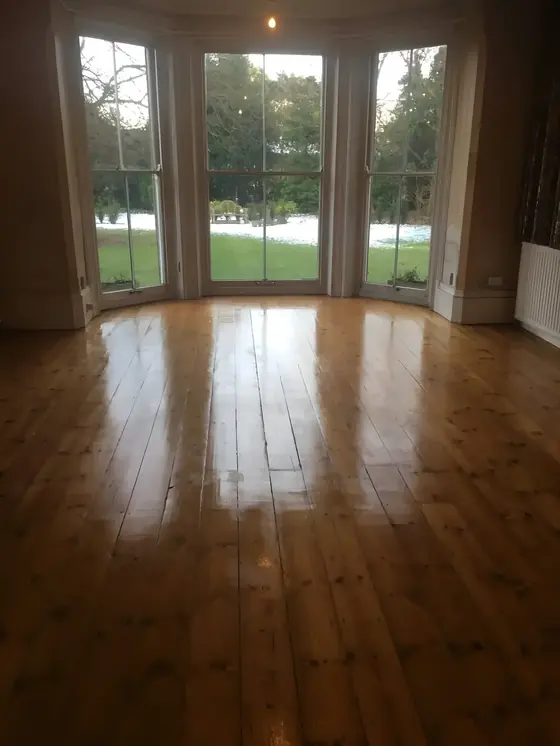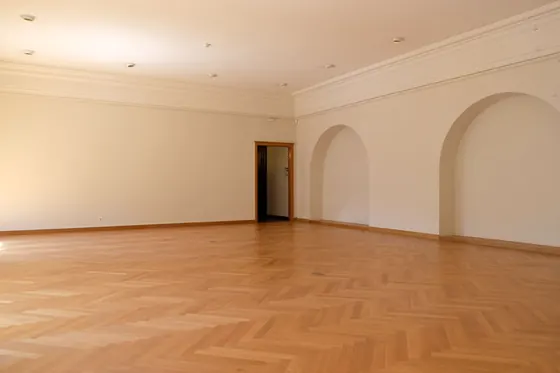
Parquet floor restoration in Cambridge
Old parquet often looks beyond help: grey, scratched, stained under rugs and dotted with loose blocks. In most cases the hardwood blocks are still solid, and parquet floor restoration brings back the colour and the pattern. Ours is carried out by Chris, the wooden floor specialist who works with our decorators. You can meet Chris on our videos page.
Graham visits first, with Chris where needed, and sends a written quotation. You can book the floor on its own, or alongside decorating in the same rooms, which is covered on our main floor sanding and restoration page.
What we check before the sanding starts
Solid woodblock floors, the kind laid in many 1930s to 1960s houses, schools and halls, have thick blocks that can usually be sanded more than once. Engineered parquet panels and thin mosaic parquet have a much shallower layer of hardwood and may only take a light sanding, if any. Chris checks the thickness at a doorway or floor vent before anything is quoted.
Tapping the floor finds hollow blocks that have come away from the adhesive. A few loose blocks are normal in an old floor. Large areas lifting or arching upwards usually point to damp, a leak or a floor that has had water on it, and the cause needs finding and fixing before the floor is restored, or it will happen again.
The black adhesive under old woodblock
Older parquet was often laid in a black bitumen adhesive. Some of these adhesives contain asbestos, so if your floor is old and blocks are loose or the adhesive is showing, a sample should be tested before anyone lifts blocks, scrapes the adhesive or sands near it.
If the test finds asbestos, removing or disturbing that adhesive is a job for an asbestos specialist, not for us. Sanding firmly fixed blocks doesn't normally reach the adhesive, unless it has squeezed up between them, but re-fixing loose blocks does, which is why we ask about testing at the visit rather than on the day.
Loose, missing and damaged blocks
Once the adhesive is known to be safe to work on, the usual approach is to lift each loose block, clean the old adhesive off the block and the subfloor, and stick it back down with a suitable flooring adhesive. Blocks that are split or burnt are swapped out.
Missing blocks are replaced with matching ones, ideally reclaimed blocks of the same timber and size, because new wood is often a different shade. Any replacements will look a little lighter at first, and sanding and oiling the whole floor together helps them settle in.
How parquet floor sanding differs from floorboards
On floorboards the sander runs along the grain. On herringbone or basketweave parquet the grain changes direction every block, so whichever way the machine travels it is cutting across half of them. Parquet sanding is therefore done in stages, with the belt sander working diagonally for the heavy passes and finer grades taking out the scratch pattern.
The edging sander takes care of the border and the strip along the skirting, and the final smoothing is done with a Mirka dust-free sander, which removes the fine swirls that would otherwise show once the oil goes on. Chris takes off as little timber as possible, because every millimetre counts on a floor that may have been sanded before.
Filling gaps and finishing the floor
Small gaps between blocks are filled with the floor's own sawdust mixed with Induro Morrells Mix & Fill, so the filler matches the timber. Wider gaps around the edges, often where a floor has shrunk away from the walls, may need a different repair, and Chris will tell you which at the visit.
Osmo Polyx oil, clear or tinted, is the finish documented on our floor work, and Graham will talk through the options at the visit. Because the oil soaks into the wood, it brings out the light and dark of blocks laid in different directions, which is what makes a herringbone pattern stand out. For an idea of what a tinted Osmo finish looks like, see the gold-oiled floorboards Chris finished in Haddenham; that job was floorboards, but the oil is the same family. Worn patches can later be cleaned and re-oiled without sanding the whole room.
What affects the price of restoring parquet
The written quotation lists each part, so you can see where the cost lies.
- Floor area and the pattern, as borders and herringbone take longer
- How many blocks are loose, missing or damaged
- Asbestos testing of old adhesive, and any specialist work it leads to
- The condition of the old finish, including paint or carpet glue
- How much gap filling is needed
- Clear or tinted oil, and decorating in the same rooms
Arranging a parquet floor visit
Get in touch and Graham will arrange a visit. It helps to lift a rug or a corner of carpet beforehand so the blocks can be seen, and to mention anything you know about the floor's history, such as a past leak. The quotation usually comes by email.
Parquet is common in hallways, so the floor is often done with the hall, stairs and landing or a natural-wood staircase at the same time. The room needs to be empty while Chris works, and we'll agree who moves what. When the last coat has dried, you look round the floor with us, and you don't pay until you're happy with it.