Hallway decorating in Cambridge, top to bottom
A hall, stairs and landing is usually one continuous space: the walls run from the front door up past the half landing to the top floor, so it's decorated as one job. We do hallway decorating and stairwell painting across Cambridge, covering ceilings, walls, banisters, spindles, handrails, doors and skirtings, and wallpaper where you want it.
It's work our decorators do often, and a sizeable share of our reviews are for exactly this. In one Cambridge family home we carried a blend of Farrow & Ball and Little Greene colours through the hall, stairs and living spaces, shown in the hallways and living spaces case study.
Height and access over the stairwell
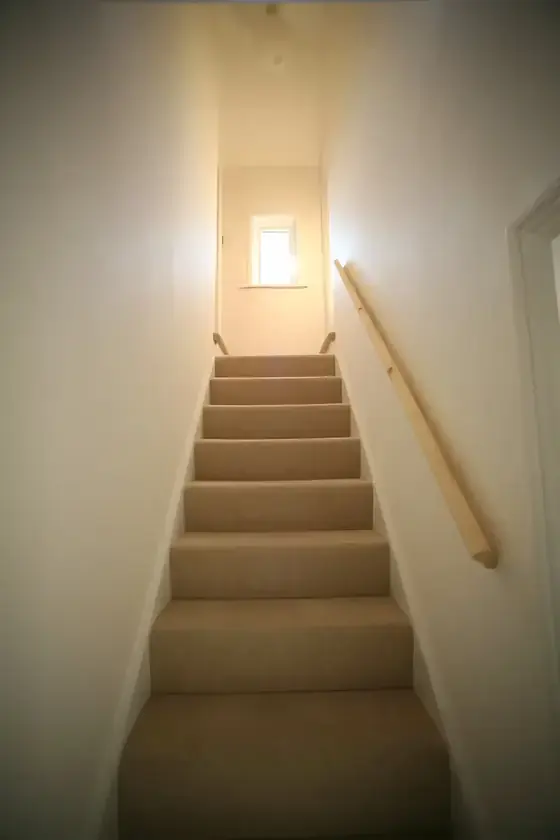
The stairwell is what makes this job different from a bedroom. The wall above the stairs can be the tallest in the house, there's no level floor beneath it, and a stepladder balanced on a tread is not safe. Before work starts we set up safe access over the stairs so the decorator can reach the top of the wall and the ceiling without leaning or stretching. That setup is planned during Graham's visit, since it depends on the shape of the stairs, the landing and how much room there is at the bottom.
Height also affects the finish. Long walls are cut in and rolled in sections that have to blend without lap marks, so we work each wall to a wet edge from top to bottom rather than leaving half of it overnight.
Keeping the stairs usable while we work
Unlike most rooms, you can't simply shut the door on a hall and staircase. Everyone in the house needs to get up and down. We plan the order of work around that, and the usual approach is:
- Covering the treads with protection that is fixed in place and won't slide underfoot
- Leaving a clear route up and down at the end of every day, with access equipment moved or made safe
- Painting banisters, handrails and spindles in stages, so there's always a dry rail to hold
- Telling you which surfaces are wet before we leave, and when they'll be fine to touch
- Doing the hall floor area last, after the walls above are finished
What customers notice
One customer who had their hall, doors, window frames and banister rails painted wrote that, "despite this being a hallway and stairwell and lots of interruptions as people had to get past, there were no complaints or remarks". Another, in CB4, who had a three-storey landing and stairs painted and the handrails varnished, said: "He tidied up every evening, so that we wouldn't have known he'd been here during the day." (both Checkatrade customers).
Finishes that stand up to a busy hall
Halls take more wear than any other room: bags, bikes, pushchairs, shoulders on the stairs and hands on the walls. A soft, chalky matt looks lovely but marks quickly here. For the walls we often suggest a washable matt, such as Little Greene Intelligent Matt Emulsion, which is breathable and touches up well once cured, or a tougher wipeable finish in your chosen brand.
Woodwork on stairs gets handled constantly. Spindles, strings and skirtings suit a hard-wearing satin or eggshell; on a whole-house project we used Tikkurila white satinwood on the woodwork. Handrails that are varnished or stained are a separate process, covered on our staircase painting page, and in Fordham Valter and Denes stained a staircase and doors for Mrs M Turner, who singled out "the staining on the staircase and doors".
A dado or panelling splits the wall into a tougher lower half and a lighter upper half, which is a practical way to give a narrow Victorian hall a harder-wearing finish where it's needed.
Papering a stairwell
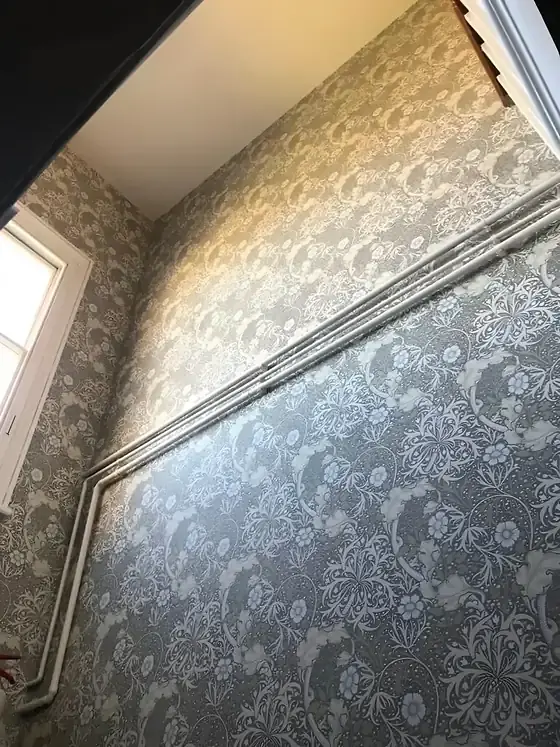
Wallpaper on a staircase is a step up in difficulty, with long drops, out-of-plumb walls and a pattern that has to line up all the way up. Our largest example is a William Morris paper hung through the hall, stairs and landing over three levels in central Cambridge, after our master plasterer had dealt with the ceilings. The William Morris staircase project shows the finished stairwell, and our designer wallpaper hanging page explains how a pattern is matched over that height.
Preparation in halls and landings
Hallways collect cracks where the stairs meet the wall and along the ceiling line, plus dents from years of traffic. We rake out and fill cracks, fill and sand dents in woodwork, and sand with our Mirka dust-free sanders so dust doesn't drift up the stairwell into the bedrooms. Old radiators, meter cupboards and the under-stairs door are all part of the job and are included in the quotation if you want them done.
What affects the price
Each of these is itemised in the written quotation.
- The height of the stairwell and how many floors it spans
- The number of spindles, doors, skirtings and windows
- Paint only, or wallpaper on some or all of the walls
- The condition of the walls and ceilings, and any plastering needed
- A colour change, especially dark to light, which may need extra coats
- Staining or varnishing banisters as well as painting
What happens after you get in touch
Graham visits, walks the stairs with you and works out the access and the order of work, including anything you need around school runs or childcare. One CB23 customer who had two rooms, hall, stairs and landing painted mentioned that the team fitted the order of work around their childcare. The written quotation follows, usually by email, and you don't pay until you're happy with the finished hall. For other rooms, see our interior decorating service.