
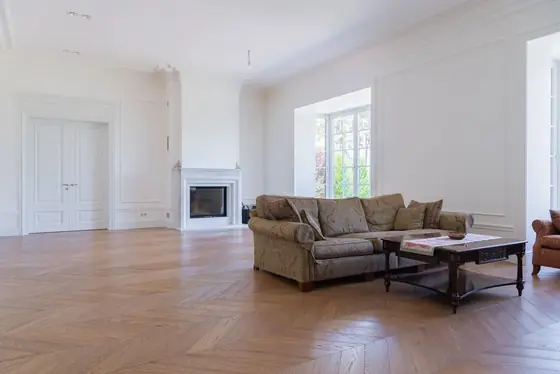
Floor sanding in Comberton's older houses
Council Tax records show around 70 homes built before 1900 and roughly 80 more from 1900 to 1939. Those are the likeliest to have original boards, and lifting the corner of a carpet in an upstairs room is the quickest way to see what's there.
In the village's many 1960s and 1970s houses the floor could be almost anything, so Chris checks before quoting. Solid hardwood sands well, engineered boards may take one light sand or none, and laminate can't be sanded at all.
From grey boards to oiled timber
Chris uses a belt sander for the main floor and an edging sander along the skirtings, fills gaps with the floor's own sawdust mixed with Induro Morrells Mix & Fill, and smooths the result with a Mirka dust-free sander. The same approach produced the gold-oiled floor in Haddenham.
Comberton at a glance
- 12 milesby road from our Landbeach base, about 18 minutesOSRM routing
- 8%of properties were built before 1919VOA Council Tax stock
- 7%date from 1919 to 1939VOA Council Tax stock
- 18%are terracedCensus 2021
- 42listed buildingsHistoric England
- 972householdsCensus 2021
How we approach floor sanding
Loose boards are secured and protruding nails punched below the surface before the belt sander goes over the floor. After gap filling and a final pass with the Mirka, Chris applies Osmo Polyx oil in thin coats, clear or tinted. Where decorating is booked too, the floors go after the walls so dust doesn't land on fresh paint. The full method, products and FAQs are on our floor sanding page.