
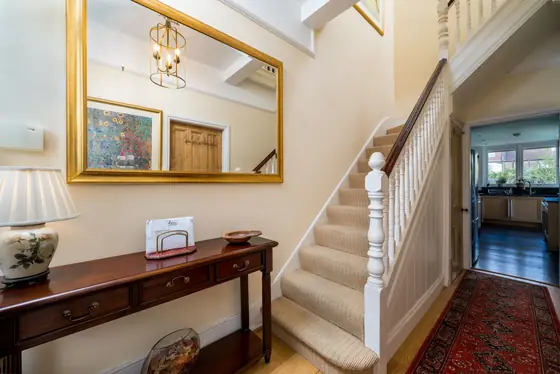
Staining staircases and doors in Comberton
A staircase is often the most visible woodwork in a 1960s or 1970s house, and some have timber handrails or treads under years of worn varnish. We sand treads, spindles and handrails evenly so the stain takes without blotches, test the colour on a hidden spot, then add a clear protective coat where hands and feet wear it.
In Fordham, Valter and Denes stained a staircase and doors for Mrs M Turner, who singled out the staining in her review. Stairs in Comberton would get the same care.
Older timber and listed interiors
The 70 or so houses built before 1900 are the most likely to have panelled doors, deep skirtings and exposed beams. Beams are cleaned and sanded, then oiled with Osmo, as at the Old Telephone Exchange in Fulbourn.
If your house is listed, ask the council about changing historic finishes before we start.
Comberton at a glance
- 12 milesby road from our Landbeach base, about 18 minutesOSRM routing
- 8%of properties were built before 1919VOA Council Tax stock
- 7%date from 1919 to 1939VOA Council Tax stock
- 93%are houses rather than flatsCensus 2021
- 42listed buildingsHistoric England
- 75%of homes are owner-occupiedCensus 2021
How we approach woodwork staining & varnishing
Old varnish and polish are sanded off so the new finish takes evenly, gaps between skirtings and walls are filled, and bare pine is primed with Zinsser to stop knots bleeding through. Painted woodwork gets an undercoat and two top coats in gloss, satin or eggshell, with a light sand between each coat. The full method, products and FAQs are on our woodwork staining & varnishing page.