
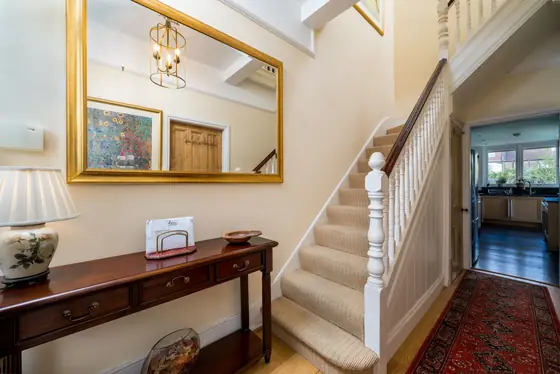
Staircase and door staining in larger Girton homes
A four-bedroom house has a lot of internal doors and often a long landing. When they were finished in orange pine varnish or yellowed gloss decades ago, they date the whole house however fresh the walls look.
We can strip and restain a staircase so the timber shows, or prime and paint it in eggshell for a softer, modern look. In Fordham, Valter and Denes stained a staircase and doors for Mrs M Turner, who thanked them for the amazing transformation. While we work, we agree a route with you so the stairs stay usable.
1930s joinery and later trim
About 18% of Girton's stock is interwar, and houses from then often keep panelled doors, deep skirtings and picture rails. Old gloss on these is sanded back, dents filled, and bare patches primed before new coats go on.
In newer homes, softwood trim and pine doors often need knots sealed first. We prime bare pine with Zinsser, as we did on a Farrow & Ball job in Cambridge, so resin doesn't bleed through. Beams and oak can be finished in Osmo oil instead of paint, and our staining and varnishing page explains the choice.
Girton at a glance
- 8 milesby road from our Landbeach base, about 18 minutesOSRM routing
- 5%of properties were built before 1919VOA Council Tax stock
- 18%date from 1919 to 1939VOA Council Tax stock
- 87%are houses rather than flatsCensus 2021
- 12listed buildingsHistoric England
- 71%of homes are owner-occupiedCensus 2021
How we approach woodwork staining & varnishing
For a Girton staircase we sand treads, spindles and handrail by hand and with dust-free sanders, then test the stain on a hidden spot. The stain goes on in an order that avoids lap marks, followed by a hard-wearing clear coat on the treads and rail. Painted doors are done panels first, then the rails and stiles. The full method, products and FAQs are on our woodwork staining & varnishing page.