
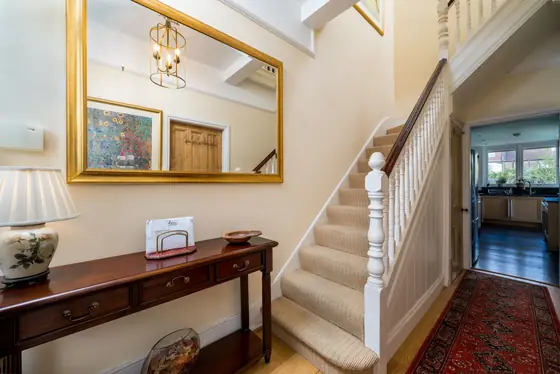
Woodwork staining for new Northstowe staircases
If your staircase is softwood, perhaps left bare or only primed by the builder, staining it evenly takes careful sanding, because any patch of filler or old sealer takes the colour differently. We test the stain on the underside of a tread first so you can approve it.
A clear protective coat then goes on the treads and handrail, where wear is heaviest. Valter and Denes did exactly this on a staircase in Fordham, and the customer, Mrs M Turner, thanked them for the staining above all.
Doors and skirtings with a better finish
New doors and skirtings often arrive with a single quick coat. We fill gaps where skirtings meet the wall, sand, and finish in satin, eggshell or gloss. Painting woodwork in the wall colour, or a shade darker, gives a calmer room.
Any bare pine is primed with Zinsser first so knots don't bleed through, as in this Farrow & Ball redecoration. For oiled timber and beams, see our woodwork staining and varnishing page.
Northstowe at a glance
- 13 milesby road from our Landbeach base, about 18 minutesOSRM routing
- 1%of properties were built before 1919VOA Council Tax stock
- 0%date from 1919 to 1939VOA Council Tax stock
- 89%are houses rather than flatsCensus 2021
- 2listed buildingsHistoric England
- 72%of homes are owner-occupiedCensus 2021
How we approach woodwork staining & varnishing
Joinery is cleaned and sanded with Mirka dust-free sanders, knots are sealed and bare timber primed. For stain, we sand evenly and test on a hidden area before working panels first, then rails and stiles. Painted woodwork gets undercoat and two top coats, lightly sanded between each, and caulked joints so lines look crisp. The full method, products and FAQs are on our woodwork staining & varnishing page.