Staircases and doors in larger Over homes
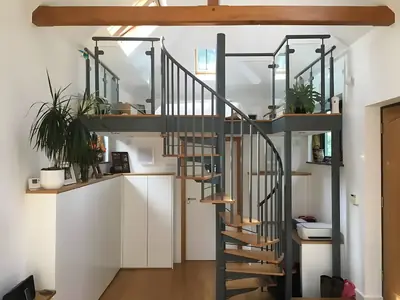
Bigger houses mean more doors and longer stairs, and the stairs have to stay usable while finishes dry. We agree a route up and down with you, sand treads and spindles evenly so stain takes without blotching, and put a clear protective coat over treads and handrails.
Out in Fordham, Mrs M Turner had her staircase and doors stained by Valter and Denes, and it was the staining she mentioned first when she wrote to thank them. Our reviews page has her comments in full.
Period woodwork and painted finishes
Over's older housing is mostly Victorian, and it's in those houses that deep skirtings, panelled doors and picture rails tend to turn up. We fill dents, sand out old drips and fill gaps along skirtings so the paint line is crisp, then finish in gloss, satin or eggshell.
Any bare pine in an Over house gets a coat of Zinsser primer before the undercoat, which stops resin from the knots staining the finish. Exposed beams and timber worktops can be oiled with Osmo.
Stairs, doors and skirtings in Over, mostly in post-1965 houses
Most of the joinery in Over belongs to houses built from 1965 onwards: Council Tax records date 78.8% of properties to that period. So in most homes the woodwork is modern, and the work is usually refreshing skirtings, doors and staircases in paint, stain or varnish rather than restoring period joinery. Varnish suits handrails and doors that are handled every day, because it forms a tough clear layer, while oil soaks into the grain and is easier to top up later.
The nearest documented woodwork job is about 5.7 miles away in a straight line, in a Victorian house in Histon, where the picture rails, cupboard doors, door frames and skirtings were made good, primed, undercoated and finished in white.
A Checkatrade review from December 2022, for lounge walls, ceiling, coving, skirting boards and doors on a job in the CB24 postcode district, which includes Over and nearby villages, notes that the decorator “cleaned up after everyday so we could still use the room”.
Figures from Valuation Office Agency Council Tax stock by build period; Historic England's National Heritage List. Contains public sector information licensed under the Open Government Licence v3.0. © Crown Copyright 2026. Contains Ordnance Survey data © Crown copyright and database right 2026. Released under OGL.
Over at a glance
- 7 milesfrom our Landbeach base in a straight line, about 18 minutes by roadOSRM routing
- 11%of properties were built before 1919VOA Council Tax stock
- 4%date from 1919 to 1939VOA Council Tax stock
- 95%are houses rather than flatsCensus 2021
- 37listed buildingsHistoric England
- 84%of homes are owner-occupiedCensus 2021
Sources: Census 2021 for Over parish (ONS); Council Tax: stock of properties, 2026; Historic England listed buildings; road distance by OSRM.
Listed buildings and conservation areas in Over
- Church of St MaryGrade I listed
- 32, West StreetGrade II listed
- 36, West StreetGrade II listed
- OverConservation area
Sources: Historic England listed buildings; Historic England conservation areas.
Listed buildings: check before changing original woodwork
If your house is one of the 37 list entries in Over, talk to South Cambridgeshire District Council before stripping, replacing or changing the finish on original doors, staircases or panelling. Its listed buildings page says consent is required for work that affects the character of the building, and the council publishes a Listed Buildings SPD and a listed buildings leaflet as well.
Listed buildings, Greater Cambridge Shared Planning · Listed Buildings SPD (PDF) · Listed buildings leaflet (PDF)
How we approach woodwork staining & varnishing
In an Over house we start by agreeing which doors come off their hinges and which are done in place, and how you'll use the stairs while coats dry. Old gloss and varnish are cleaned and sanded for a key, gaps along skirtings and architraves are filled, and bare pine is primed with Zinsser so knots don't bleed through. For natural wood, a stain sample goes on the back of a door for your approval first, and treads and handrails get a clear protective coat. Our woodwork staining & varnishing page sets out each step, the products we use and the questions people ask most.
Paint applied to woodwork before the 1960s may contain lead, so it should be tested before anyone sands it; if lead is found it is never dry sanded or burnt off, but prepared with wet, low-dust methods and the area cleaned thoroughly afterwards.