
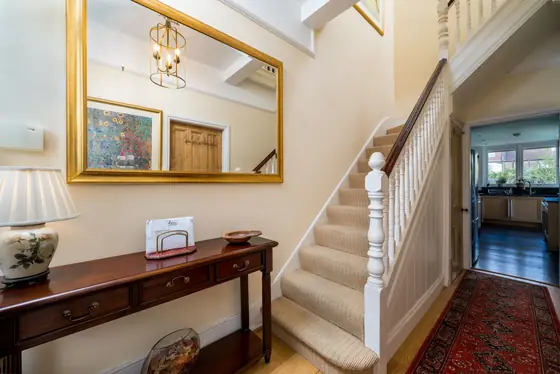
Period joinery and modern doors
Around 230 Willingham properties were built before 1900, according to Council Tax records. Houses of that age tend to have deeper skirtings, panelled doors and sometimes exposed beams, all of which need sanding and filling before a new finish. Listed homes, of which the parish has 32, call for extra care with original timber.
Newer houses are simpler: smooth doors, standard skirtings and a stair with spindles. They still need cleaning and keying, because old gloss is too shiny for a new coat to grip.
Staining, varnishing, oiling or painting
Stain colours timber and lets the grain show, with a clear coat over the top on treads and handrails. Oil soaks in and leaves a matt, natural look; at the Old Telephone Exchange in Fulbourn we oiled the exposed beams with Osmo. Painted woodwork can be gloss, satin or eggshell, and bare pine is primed with Zinsser first so knots don't bleed through.
Willingham at a glance
- 8 milesby road from our Landbeach base, about 14 minutesOSRM routing
- 15%of properties were built before 1919VOA Council Tax stock
- 7%date from 1919 to 1939VOA Council Tax stock
- 93%are houses rather than flatsCensus 2021
- 32listed buildingsHistoric England
- 70%of homes are owner-occupiedCensus 2021
How we approach woodwork staining & varnishing
We test stain on a hidden spot, such as the underside of a tread, so you approve the colour first. Timber is sanded evenly with Mirka dust-free sanders, since leftover varnish takes stain differently. Panelled doors are done panels first, then rails and stiles, and a route up and down the stairs is kept while it dries. The full method, products and FAQs are on our woodwork staining & varnishing page.