
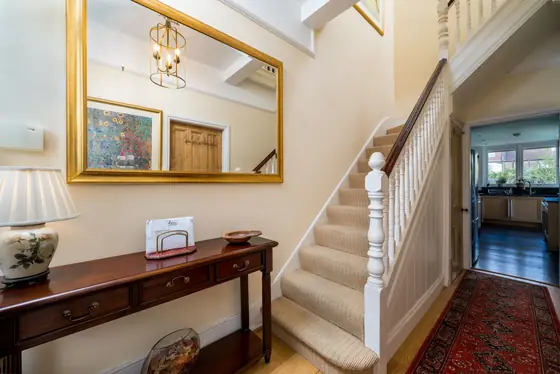
Old joinery in Swavesey's period homes
Original woodwork often has runs, drips and open joints from earlier paint jobs. We fill, sand and prime before any finish, and on bare pine we use Zinsser to stop knots bleeding through. Satin and eggshell suit uneven old timber better than high gloss because they show fewer imperfections.
In a Victorian house in Histon, picture rails, cupboard doors and skirtings were all made good, primed, undercoated and finished in white.
Staining stairs and doors in Swavesey
Natural timber needs even sanding before stain, or old varnish left in patches shows as pale spots. We test the colour on a hidden area first. Panelled doors are stained panels first, then rails and stiles, so wet edges don't overlap. Treads and handrails get a clear protective coat on top.
Larger homes are common here, with about 38% having four or more bedrooms, so a staircase and a full set of doors is often a substantial job. Exposed beams can be cleaned, sanded and oiled with Osmo.
Swavesey at a glance
- 14 milesby road from our Landbeach base, about 20 minutesOSRM routing
- 14%of properties were built before 1919VOA Council Tax stock
- 5%date from 1919 to 1939VOA Council Tax stock
- 87%are houses rather than flatsCensus 2021
- 28listed buildingsHistoric England
- 72%of homes are owner-occupiedCensus 2021
How we approach woodwork staining & varnishing
We clean handles and grubby edges, sand old gloss to a key and fill dents and gaps along skirtings. For stain, timber is sanded evenly and a test patch approved first. Bare wood is primed with Zinsser, and we sand lightly between coats. The sanders extract as they go, so the landing and hall stay clean. The full method, products and FAQs are on our woodwork staining & varnishing page.