
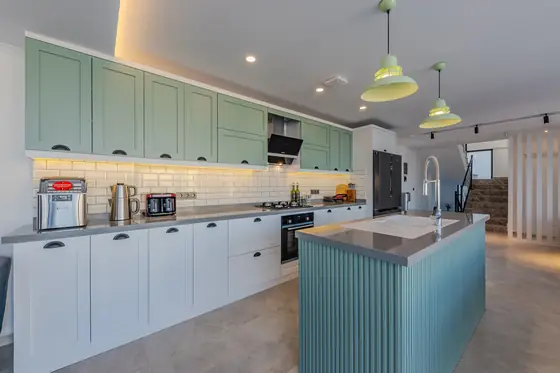
Fitted kitchens in Over's 1980s, 1990s and newer houses
Council Tax records date about a fifth of the village's homes to 1983–1999, and more than a fifth again to 2000 onwards. Kitchens fitted in those decades often have sound carcasses and a layout that still works, with doors that have yellowed or gone patchy around the handles.
Painted timber, solid wood and MDF doors generally take paint well once properly prepared. Graham checks what yours are made of and says plainly if a finish won't hold paint.
Brush, roller or sprayer
Larger kitchens with long runs of slab doors suit our Graco Ultra cordless airless handheld sprayer, once worktops, floors and appliances are sheeted. Smaller kitchens or Shaker doors are often better by brush. Either way the paint is a proper woodwork eggshell or satin from Tikkurila, Farrow & Ball or Dulux.
Timber worktops can be sanded and oiled with Osmo at the same time, as we did at the Old Telephone Exchange in Fulbourn.
Over at a glance
- 9 milesby road from our Landbeach base, about 18 minutesOSRM routing
- 84%of homes are owner-occupiedCensus 2021
- 36%of households own with a mortgageCensus 2021
- 20%were built 1983 to 1999VOA Council Tax stock
- 22%were built since 2000VOA Council Tax stock
- 95%are houses rather than flatsCensus 2021
How we approach kitchen cabinet painting
Doors are labelled, handles removed and every surface degreased, with most attention near the hob and the bin. We sand with Mirka dust-free sanders, fill chips and pick a Zinsser primer to suit the old finish. Two top coats follow, laid off by brush or sprayed, with the sink and fridge kept reachable where we can. The full method, products and FAQs are on our kitchen cabinet painting page.