Which Over floors suit sanding
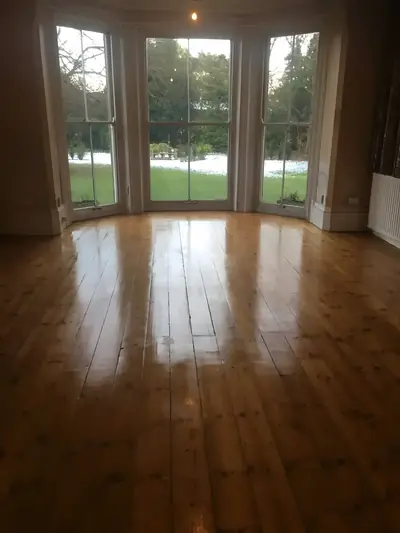
Victorian pine boards are the classic candidate, often found by lifting a corner of carpet. Solid hardwood floors laid in later houses can also be sanded and refinished. Engineered boards have a thin wear layer that may take only limited sanding, and laminate can't be sanded at all.
Chris, our wooden floor specialist, checks what you have before anything is quoted, and he'll tell you if sanding isn't the answer.
From bare boards to an oiled finish
Chris sands with a belt sander and an edging sander, fills small gaps with the floor's own sawdust mixed with Induro Morrells Mix & Fill, then finishes with a Mirka dust-free sander. The Haddenham floor restoration shows that process ending in Osmo Polyx tint oil in Gold.
If decorating is planned too, we schedule the floor so sanding dust never lands on fresh paint, and our decorators touch in the skirtings afterwards.
Original boards in Over belong to a pre-1945 minority
Original floorboards worth sanding are mostly found in older houses, and Over has fewer of those than England as a whole. Council Tax records date 15.9% of its properties to before 1945, and the interwar share is especially small: 4.5% from 1919 to 1939, against 14.8% across England. Sanding original pine is therefore the less common floor request in Over, and it mainly suits owners of that older minority.
The nearest documented floor job is about 6.2 miles away in a straight line: the gold-oiled floor in Haddenham, near Ely, where Chris restored the dining and living room floors and finished them in Osmo Polyx tint oil in Gold. In a newer Over house, a solid hardwood floor laid later can be a candidate too, so it's worth asking even if your home was built long after the war.
Looking after an oiled floor is mostly about grit and spills: sweep or vacuum often so grit can't scratch the surface, fit felt pads under chair and table legs, and wipe spills up rather than letting them soak in. Chris gives advice on your particular oil once the floor is finished.
Figures from Valuation Office Agency Council Tax stock by build period; Historic England's National Heritage List. Contains public sector information licensed under the Open Government Licence v3.0. © Crown Copyright 2026. Contains Ordnance Survey data © Crown copyright and database right 2026. Released under OGL.
Over at a glance
- 7 milesfrom our Landbeach base in a straight line, about 18 minutes by roadOSRM routing
- 11%of properties were built before 1919VOA Council Tax stock
- 4%date from 1919 to 1939VOA Council Tax stock
- 9%are terracedCensus 2021
- 37listed buildingsHistoric England
- 1,159householdsCensus 2021
Sources: Census 2021 for Over parish (ONS); Council Tax: stock of properties, 2026; Historic England listed buildings; road distance by OSRM.
How we approach floor sanding
Chris looks at the floor before anything is quoted, since an Over house could have original pine boards, a later hardwood floor or a surface that can't be sanded. The room is emptied and the doorways sealed, loose boards are secured and nails knocked below the surface, and the belt and edging sanders take off the old finish. Gaps are filled with the floor's own sawdust mixed with Induro Morrells Mix & Fill, a Mirka dust-free sander does the final pass, and thin coats of Osmo oil finish it. For the full method and the products we use, see our floor sanding page.
Old paint or stain around the edges of a pre-1960s floor may contain lead. A test before sanding settles it, and lead paint is only ever prepared with wet or low-dust methods, never sanded dry.