
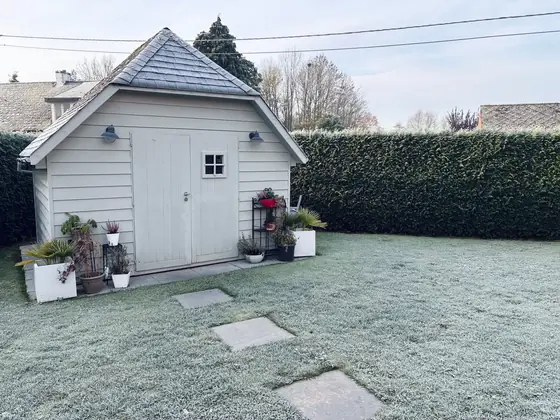
Gardens behind almost every Girton house
The 2021 Census counts 739 detached houses and 624 semis in the parish, against 167 terraces. Detached and semi plots tend to have fencing down both sides and across the back, plus side gates that take a lot of handling. That's a long run of timber to keep in good order.
Fence posts and gravel boards fail first, so they get a proper coat rather than a quick pass. Gates have every face finished, including the top and bottom edges where end grain soaks up water.
Shed and fence painting: cleaning first, then the finish
Green algae on the shady side of a fence stops any finish soaking in. Where it suits the timber we clean with an anti-fungal wash, taking a gentler approach on rough-sawn panels than on painted sheds, and let it dry out fully.
Then it's a choice between an opaque garden paint, which gives one even colour across weathered boards, and a stain that lets the grain show. John Dunn in Cambridge was delighted with how Denes finished his shed, and you'll find comments like his on our reviews page. More detail is on the shed and fence painting page.
Girton at a glance
- 8 milesby road from our Landbeach base, about 18 minutesOSRM routing
- 87%are houses rather than flatsCensus 2021
- 42%of homes are detachedCensus 2021
- 36%are semi-detachedCensus 2021
- 71%of homes are owner-occupiedCensus 2021
- 1,747householdsCensus 2021
How we approach shed, fence & gate painting
We clear algae and dirt, scrape and sand flaking paint on sheds and gates, sand down raised fibres and protect plants and paving. Rotten boards or posts are flagged before we start. Finishes go on in dry weather, usually late spring to early autumn, and on sheds the door edges and the undersides of window frames are done with particular care. The full method, products and FAQs are on our shed, fence & gate painting page.