
Floor sanding for Linton's period homes
Victorian pine boards are the usual find. They're often sound timber under worn stain and old varnish, with gaps between boards and a few later patches. Lifting a corner of carpet is the quickest way to see what you have.
Engineered boards can be sanded only a limited number of times, if at all, and laminate not at all. Chris checks before anything is quoted.
Gap filling and oiling
Small gaps between boards are filled with the floor's own sawdust and Induro Morrells Mix & Fill, so the filler is close in colour to the wood. After that come final passes with a Mirka dust-free sander and Osmo oil in thin coats.
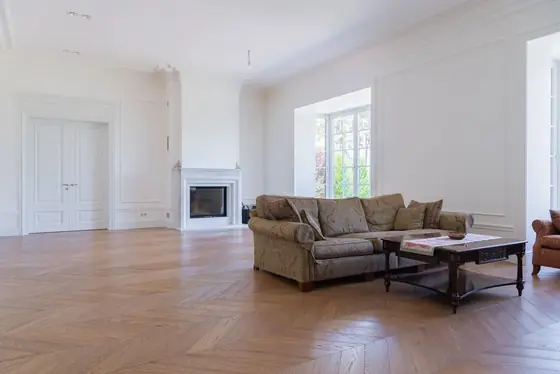
Polyx hardwax oil soaks in and hardens, bringing out the grain. A tint such as the Gold we used in Haddenham warms the colour, while clear keeps the timber close to its freshly sanded look. If you're decorating too, interior decorating in Linton can be planned around the floor.
Linton at a glance
- 20 milesby road from our Landbeach base, about 26 minutesOSRM routing
- 15%of properties were built before 1919VOA Council Tax stock
- 4%date from 1919 to 1939VOA Council Tax stock
- 17%are terracedCensus 2021
- 125listed buildingsHistoric England
- 1,881householdsCensus 2021
How we approach floor sanding
Chris secures loose boards and sets nails below the surface, then sands with a belt sander through coarse to fine paper and an edging sander along the skirtings. Gaps are filled with sawdust and Mix & Fill, the floor is smoothed with the Mirka sander, and Osmo oil goes on thinly with drying time between coats. The full method, products and FAQs are on our floor sanding page.