Sash window painting in Linton
Graham looks at each window at the visit: flaking paint, bare timber, open joints, soft patches, loose putty and sashes painted shut. The quotation then lists every window and the work it needs, so you can do the weather-facing side first.
Old windows can carry lead paint in their lower layers, so we sand with Mirka dust-free sanders that extract at the pad. Bare timber is primed, joints are filled, and sills and bottom rails get extra attention.
Listed windows and carpentry
Our job is the decorative side, while sash cords, rotten timber and replacement sashes go to our carpenter, planned with the painting.
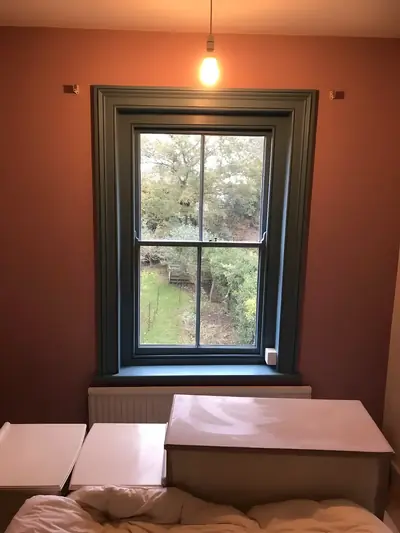
Inside, a coloured frame can look striking. We painted one in Fired Earth Turkish Blue eggshell in a Cambridge bedroom.
Timber sashes in Linton: pre-1900 houses and listed homes
Nearly all of Linton's pre-1919 homes are older than 1900: Council Tax records show only around 20 built from 1900 to 1918. So where original timber sashes survive in the village, they are most likely on Victorian or earlier houses, probably under many coats of paint. Old layers can contain lead, so the paint is tested before work starts, and if the test is positive it is never sanded dry.
Linton's listed homes include Victoria House and Osnaburgh House, both Grade II, and the parish has one conservation area, with its own 2022 appraisal. On a listed house, or one inside the conservation area boundary, a change of window colour is a question for the council before it is one for us, and the note below links the pages to check.
Inside, shutters, window boards and reveals can be decorated in the same visit as the sashes, so the whole window is finished together.
Figures from Valuation Office Agency Council Tax stock by build period; Met Office 1991-2020 climate averages; Historic England's National Heritage List; Historic England conservation areas. Contains public sector information licensed under the Open Government Licence v3.0. © Crown Copyright 2026. Contains Ordnance Survey data © Crown copyright and database right 2026. Released under OGL. © Historic England and Local Planning Authorities 2026.
Linton at a glance
- 13 milesfrom our Landbeach base in a straight line, about 26 minutes by roadOSRM routing
- 15%of properties were built before 1919VOA Council Tax stock
- 125listed buildingsHistoric England
- 1conservation areaHistoric England
- 17%are terracedCensus 2021
- 4%date from 1919 to 1939VOA Council Tax stock
Sources: Census 2021 for Linton parish (ONS); Council Tax: stock of properties, 2026; Historic England listed buildings; Historic England conservation areas; road distance by OSRM.
Listed buildings and conservation areas in Linton
- 1 and 3, Coles LaneGrade II* listed
- 87 and 89, High StreetGrade II* listed
- Queens HouseGrade II* listed
- LintonConservation area
Sources: Historic England listed buildings; Historic England conservation areas.
Planning: check before you change a window
If your house is listed or inside the Linton Conservation Area, talk to South Cambridgeshire District Council before changing the colour, glazing or design of its windows. The council's listed buildings page is explicit that listed building consent is required for any work that affects the character of the building, and that it is a criminal offence to carry out unauthorised work to a listed building. For homes inside the boundary, its conservation areas page adds that some works may need planning permission which would otherwise not need it.
Council page on listed buildings · Council page on conservation areas · Linton Conservation Area boundary map
How we approach sash window restoration
For a Victorian Linton sash we'd test the old paint for lead before any sanding, then take curtains and blinds down and sheet the floor under the window. Sills and bottom rails, where water sits, are filled and sealed first, and bare timber is primed with Zinsser before an eggshell or satin finish. Each sash is eased before we leave for the evening so nothing sets shut, and the room is left tidy. Each step and the products we use are explained on our sash window restoration page, with answers to common questions.
Best time of year for the work
Outside faces of sashes are best finished before autumn sets in. At the Met Office's Cambridge NIAB station, about 13 miles north-west of Linton, October is the wettest month on 1991-2020 averages, with 59 mm of rain on about 9.6 days, and air frost was recorded in October in 9 of the 30 years. We aim to complete exterior sash painting by the end of September, with the days themselves chosen from the forecast.