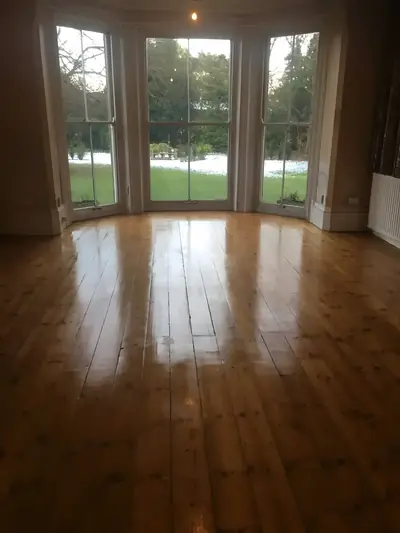
The gold-oiled floors in Haddenham
Both rooms were sanded to clean timber using a belt machine for the open floor and an edger along the walls. Small defects were repaired and the gaps between boards packed with the floor's own sawdust bound with Induro Morrells Mix & Fill, before a Mirka dust-free sander gave the last smoothing pass. Every stage is photographed in the gold-oiled floor case study.
Which homes in the parish have boards worth sanding
Council Tax records date about 240 homes in the parish to before 1919 and around 100 to the interwar years. Those are the likeliest to have original softwood boards under the carpet. Terraced houses, about 11% of the parish, are worth checking too.
Later houses vary. Many have chipboard or concrete floors, which can't be sanded, while some owners have since laid solid oak or parquet. Chris lifts a corner and tells you plainly what's there. For block floors, see parquet restoration.
Pre-1945 boards in Haddenham, and the floor we oiled in Gold
Homes built before 1945 are the likeliest to have original boards under the carpet, and Council Tax records put 23.1% of Haddenham's homes in that group: about 240 from before 1919 and 100 from 1919 to 1939. The interwar share here, 6.8%, is under half of England's 14.8%, so most of the parish's likely candidates are older still.
Our own Haddenham floor is the clearest guide to what a tinted oil does to old boards. The 19 photos in the gold-oiled floor case study show the timber freshly sanded and again after Osmo Polyx tint oil in Gold, the finish with real 24-carat flecks, so you can judge the colour before choosing between a tint and a clear oil.
A list entry such as Mill House, one of the parish's 15 Grade II entries, records a building's name and grade, not what's under its carpets. So on any older house Chris checks the floor before anything is quoted, and on a listed one it's worth asking East Cambridgeshire District Council before original boards are sanded.
Figures from Valuation Office Agency Council Tax stock by build period; Historic England's National Heritage List. Contains public sector information licensed under the Open Government Licence v3.0. © Crown Copyright 2026. Contains Ordnance Survey data © Crown copyright and database right 2026. Released under OGL.
Haddenham at a glance
- 7 milesfrom our Landbeach base in a straight line, about 16 minutes by roadOSRM routing
- 16%of properties were built before 1919VOA Council Tax stock
- 7%date from 1919 to 1939VOA Council Tax stock
- 11%are terracedCensus 2021
- 16listed buildingsHistoric England
- 1,457householdsCensus 2021
Sources: Census 2021 for Haddenham parish (ONS); Council Tax: stock of properties, 2026; Historic England listed buildings; road distance by OSRM.
How we approach floor sanding
On an older Haddenham floor, Chris first checks what's under the carpet and whether the boards are thick enough to sand, then secures any that move and punches down nails standing proud. A belt sander takes the main area through coarse to fine papers, and an edging sander does the margins by the skirting. Gaps are packed with the floor's own sawdust mixed with Induro Morrells Mix & Fill, a Mirka dust-free sander gives the final pass, and Osmo oil, clear or tinted, goes on in thin coats. How we work, step by step, and the questions people usually ask are on our floor sanding page.
On floors laid before the 1960s, painted or stained borders can contain lead, so they should be tested before any sanding; if lead is found, that part is never sanded dry and is prepared with wet or low-dust methods instead.