Skimming textured ceilings
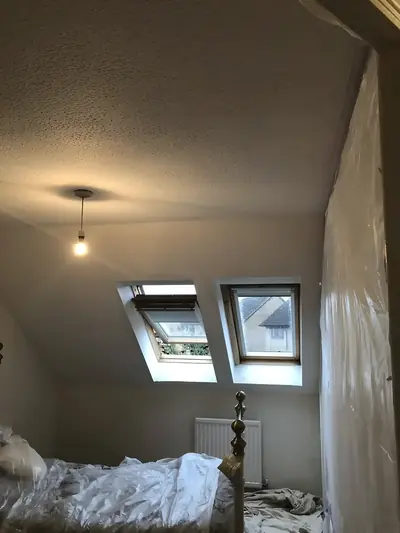
Council Tax records show around 330 homes in the parish from 1965 to 1982 and about 150 from 1945 to 1964. Many have had their textured ceilings skimmed already; others still have swirls or stipples. Lewis, our plasterer, or the master plasterer we work with, can skim straight over sound Artex once the room is sheeted.
Some Artex from past decades contained asbestos, so a sample should be tested before any sanding or scraping. Our Artex removal and skimming page explains the options.
Lath, lime and cracks in Haddenham's older houses
In pre-1919 houses, ceilings are often lath and plaster. Where a section has come away from the laths, it may have to be cut back to sound plaster and patched before any skim. Short hairline cracks can be filled during decorating, longer ones need taping and plastering, and repeated cracking along the same line is a sign to look for movement or water before decorating.
In a Cambridge bedroom we stripped and skimmed over old lath and plaster, a mist coat after skimming showed up imperfections before the finish went on.
Haddenham's post-war ceilings and pre-1900 walls
Of the Haddenham homes built between 1945 and 1982, the largest group dates from 1965 to 1972: about 200 properties in Council Tax records, with 130 more from 1973 to 1982. Homes from 1965 to 1982 make up 22.4% of the parish, against 18.2% across England, and that was an era when textured Artex ceilings were common.
At the other end of the age range, 15.0% of the parish's homes were built before 1900. Walls that old may still have their original lime or sand and stone plaster, which can be soft and patched, and they don't always need a skim. In a Victorian house in Histon, careful preparation and lining paper where needed did the job instead, before the walls were painted in Khaki Mist.
Heating is worth mentioning at the visit. The 2021 Census found 23 Haddenham households, 1.6%, with no central heating, twice the 0.8% share across East Cambridgeshire. New plaster has to dry out completely before its mist coat, and a damp patch needs its cause found and fixed before any skim, so Graham asks how each room is heated and whether any wall has been damp.
Figures from 2021 Census (ONS); Valuation Office Agency Council Tax stock by build period. Source: Office for National Statistics licensed under the Open Government Licence v.3.0. Contains public sector information licensed under the Open Government Licence v3.0.
Haddenham at a glance
- 7 milesfrom our Landbeach base in a straight line, about 16 minutes by roadOSRM routing
- 10%were built 1945 to 1964VOA Council Tax stock
- 22%were built 1965 to 1982VOA Council Tax stock
- 16%of properties were built before 1919VOA Council Tax stock
- 1,457householdsCensus 2021
- 7%date from 1919 to 1939VOA Council Tax stock
Sources: Census 2021 for Haddenham parish (ONS); Council Tax: stock of properties, 2026; road distance by OSRM.
Listed buildings: check before plastering
If your home is listed, ask East Cambridgeshire District Council before taking off or replacing old plaster. Its guidance on listed buildings notes that like-for-like repairs and maintenance using traditional materials normally won't require consent, so anything more than that is worth asking about first.
East Cambridgeshire District Council: listed buildings · East Cambridgeshire District Council: planning applications
How we approach plastering
In a 1960s or 1970s Haddenham house, the room is cleared or sheeted, light fittings and smoke alarms come down, and the ceiling is prepared so the new plaster bonds before Lewis or our master plasterer skims over the sound Artex. Older lime walls are assessed first, since patching, lining or a skim each suits a different wall. Once the plaster has dried out fully, we apply a mist coat, fill and sand anything it reveals with Mirka dust-free sanders, then finish with two coats. There is more on preparation, products and common questions on our main plastering page.