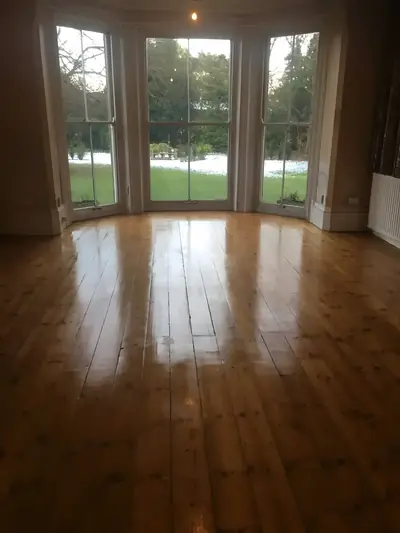
Floor sanding in Landbeach's older houses
The interwar homes, about 60 in the area, and the older cottages are the likeliest to have boards worth uncovering. At the visit we turn back a corner of carpet to check the timber, how many boards are loose and whether earlier repairs used mismatched wood. Floors in newer houses may be chipboard or engineered board, and we look at those before giving a view.
From rough boards to an oiled finish
Chris takes the main floor back with a belt sander, runs an edging sander along the skirtings, then packs the gaps with a blend of sanding dust from the same floor and Induro Morrells Mix & Fill. A final pass with a Mirka sander gets it ready for oil.
The boards in our Haddenham project were oiled in Osmo Polyx Gold tint, flecked with 24-carat gold. Clear and other tinted oils are available, and our floor sanding page covers the work in more detail.
Interwar houses and listed farmhouses: Landbeach floors worth lifting the carpet for
Floorboards worth sanding are most likely in houses built before 1945. Council Tax records for the surrounding area, where 71.3% of households live in Landbeach, date 10.2% of properties to 1919-39, well above South Cambridgeshire's 6.1% though below England's 14.8%, with a larger share again from before 1919. Many local homes are newer than that, and in those the floor under the carpet is more likely to be chipboard or engineered board, which Chris checks before saying whether sanding is worth doing.
Four of the parish's list entries are named as farmhouses, among them Old Beach Farmhouse and Manor Farmhouse. The names don't tell us what floors they have, but in any listed house it's worth asking South Cambridgeshire District Council before original boards are sanded back, since its consent covers any work that affects the character of the building.
The nearest documented floor job is the gold-oiled floor in Haddenham, about 6.6 miles away, where Chris finished the boards in Osmo Polyx tint oil in Gold.
Figures from Valuation Office Agency Council Tax stock by build period; Historic England's National Heritage List. Contains public sector information licensed under the Open Government Licence v3.0. © Crown Copyright 2026. Contains Ordnance Survey data © Crown copyright and database right 2026. Released under OGL.
Landbeach at a glance
- Under a milefrom our Landbeach base in a straight line, about 1 minute by roadOSRM routing
- 19%of properties were built before 1919 (Landbeach and the surrounding area)VOA Council Tax stock
- 10%date from 1919 to 1939 (Landbeach and the surrounding area)VOA Council Tax stock
- 12%are terracedCensus 2021
- 26listed buildingsHistoric England
- 375householdsCensus 2021
Sources: Census 2021 for Landbeach parish (ONS); Council Tax: stock of properties, 2026, for the statistical areas covering Landbeach and the surrounding area; Historic England listed buildings; road distance by OSRM.
How we approach floor sanding
For older Landbeach boards, the first decision is how far to go: back to clean timber, or keeping some of the marks that give an old floor its character. Loose boards are screwed down and nails punched below the surface before Chris starts. The belt sander works through the grades, the edging sander follows the skirtings, gaps are filled with the floor's own dust mixed with Induro Morrells Mix & Fill, and a Mirka pass smooths it. You then choose a clear or tinted Osmo Polyx oil, tried first on a corner of your own boards.
Old paint or stain around the edges of a pre-1960s floor may contain lead. A test before sanding settles it, and lead paint is only ever prepared with wet or low-dust methods, never sanded dry.