Which Milton floors can be sanded
Council Tax records list around 60 Milton properties from before 1900 and roughly 70 from the interwar years. Those are the homes most likely to have boards worth lifting a carpet for. In newer houses the floor may be chipboard, engineered board or laminate, and Chris checks what you have before anything is quoted. Engineered boards can only be sanded a limited number of times, if at all.
If your later house has had a solid oak or other hardwood floor fitted, that can usually be sanded and refinished well.
Floor sanding in Milton, from belt sander to oil
Chris secures loose boards, sets proud nails below the surface, then works the main floor with a belt sander and the edges with an edging sander.
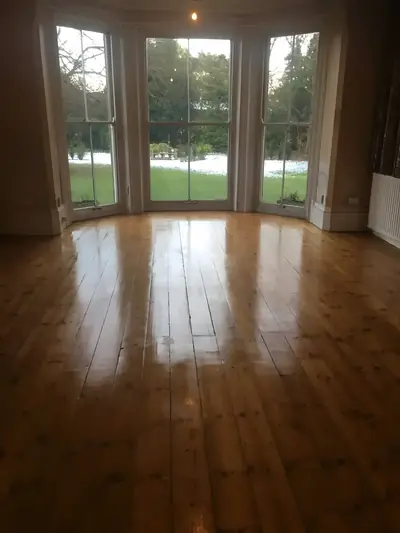
The Haddenham floor restoration shows the whole process on a floor finished in Osmo Polyx tint oil in Gold.
Floor sanding in Milton: few original boards, and the floors that can still be sanded
Council Tax records put just 2.9% of Milton's homes before 1919, about a quarter of the South Cambridgeshire figure of 11.2% and well below England's 20.0%. Add the interwar houses and the total built before 1945 is still only 130 properties, so the old pine boards that sanding is best known for lie under relatively few Milton carpets.
It still suits two groups. The first is anyone in those older houses or in one of the parish's 16 listed buildings and structures (four are numbered street addresses, such as 3, High Street), where original boards may survive under later coverings; if the building is listed, ask South Cambridgeshire District Council before original floors are sanded, as it says listed building consent is required for any work that affects the character of the building. The second is the owner of a later house who has had a solid hardwood floor laid, which can be sanded back and re-oiled once it's worn.
Engineered boards are a judgement call and laminate can't be sanded at all, so Chris checks before anything is quoted. The nearest documented floor job is the gold-oiled floor in Haddenham, about 8 miles from Milton in a straight line, finished in Osmo Polyx tint oil in Gold.
Figures from Valuation Office Agency Council Tax stock by build period; Historic England's National Heritage List. Contains public sector information licensed under the Open Government Licence v3.0. © Crown Copyright 2026. Contains Ordnance Survey data © Crown copyright and database right 2026. Released under OGL.
Milton at a glance
- 2 milesfrom our Landbeach base in a straight line, about 4 minutes by roadOSRM routing
- 3%of properties were built before 1919VOA Council Tax stock
- 3%date from 1919 to 1939VOA Council Tax stock
- 15%are terracedCensus 2021
- 16listed buildingsHistoric England
- 1,926householdsCensus 2021
Sources: Census 2021 for Milton parish (ONS); Council Tax: stock of properties, 2026; Historic England listed buildings; road distance by OSRM.
How we approach floor sanding
For a Milton floor, the visit settles whether sanding is possible at all: Chris lifts a corner of carpet, or looks at a floor that's already bare, to see whether it's solid timber. Original boards in a pre-1945 house have loose boards fixed and nails knocked below the surface before the belt and edging sanders go over them. Gaps are filled with the floor's own sawdust mixed with Induro Morrells Mix & Fill, a Mirka pass smooths everything, and Osmo Polyx oil goes on, clear or tinted. There is more on preparation, products and common questions on our main floor sanding page.
On floors laid before the 1960s, painted or stained borders can contain lead, so they should be tested before any sanding; if lead is found, that part is never sanded dry and is prepared with wet or low-dust methods instead.