
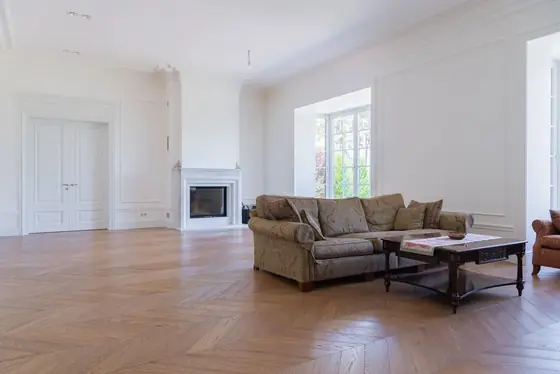
Where the original boards are
Most of the town's older stock predates 1900, around 730 homes by Council Tax records, with only about 330 from the interwar years. Lifting a corner of carpet is the quickest way to see what's underneath. Solid hardwood in newer homes can also be sanded, but laminate and vinyl cannot.
Chris, the wooden floor specialist we work with, checks the floor before anything is quoted. Engineered boards have only a thin wood layer, so he'll tell you honestly if sanding isn't the right answer.
How Chris restores a floor
First Chris fixes down any loose boards and punches nail heads below the surface. A belt sander takes off old varnish and stain, an edging sander reaches the skirtings, and gaps are filled with sawdust from your own floor mixed with Induro Morrells Mix & Fill. A Mirka dust-free sander does the final pass.
The finish is Osmo oil, clear to keep the sanded look or tinted to warm it up. The Haddenham floor went in Osmo Polyx tint oil in Gold, with flecks of 24-carat gold.
Huntingdon at a glance
- 20 milesby road from our Landbeach base, about 24 minutesOSRM routing
- 8%of properties were built before 1919VOA Council Tax stock
- 3%date from 1919 to 1939VOA Council Tax stock
- 28%are terracedCensus 2021
- 123listed buildingsHistoric England
- 10,519householdsCensus 2021
How we approach floor sanding
In an older Huntingdon terrace we'd plan the floor and decorating together, so dust never settles on fresh paint. The room is emptied, doorways sealed, and the boards checked and secured before sanding. Gaps are filled to match, the surface smoothed dust-free, and oil applied in thin coats, each left to dry before the next. The full method, products and FAQs are on our floor sanding page.