
Artex ceilings in post-war Huntingdon
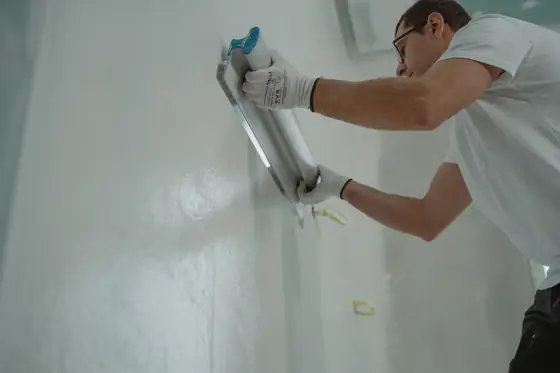
The town's biggest post-war burst came between 1955 and 1972, when more than 3,000 homes went up. Many ceilings from that era carry Artex or a similar texture. Skimming covers it with smooth new plaster, which is usually quicker and less disruptive than replacing the ceiling.
Lewis, our plasterer, or the master plasterer we work with does the skim once the room is cleared and the fittings are down. After it dries, we sand with Mirka dust-free sanders and apply a mist coat, then the decorating follows under the same quotation.
Older walls and stubborn cracks
In the older houses, stripping paper can reveal tired lath and plaster that the paper was holding together. We show you what we've found and agree the cost before any skimming. Not every old wall needs it, and sometimes lining paper is the better answer.
Ceiling cracks that keep coming back may point to movement or a leak above. Graham will say if he suspects that rather than filling and painting over it. Water stains are sealed with a Zinsser stain block first.
Huntingdon at a glance
- 20 milesby road from our Landbeach base, about 24 minutesOSRM routing
- 15%were built 1945 to 1964VOA Council Tax stock
- 21%were built 1965 to 1982VOA Council Tax stock
- 8%of properties were built before 1919VOA Council Tax stock
- 10,519householdsCensus 2021
- 3%date from 1919 to 1939VOA Council Tax stock
How we approach plastering
For a Huntingdon ceiling or wall, we cover floors and furniture, remove light fittings, prepare the surface so the plaster bonds, and skim. The plaster dries out fully before a thinned mist coat goes on. Anything that coat shows up is filled and spot-sanded, then two coats of colour follow. Coving can be hung after plastering and before the final coats. The full method, products and FAQs are on our plastering page.