
Period joinery in older Huntingdon homes
In a house of that age, decades of gloss build up into runs and drips, and joints open as the timber moves. We sand back with Mirka dust-free sanders, fill dents and gaps, and prime any bare wood with Zinsser before undercoat and top coats. Eggshell often suits old timber better than high gloss, as it shows fewer imperfections.
With 123 listed buildings in the parish, some owners will want original doors or a staircase kept as natural wood. Staining, varnishing or oiling brings out the grain, and we test the colour on a hidden area first.
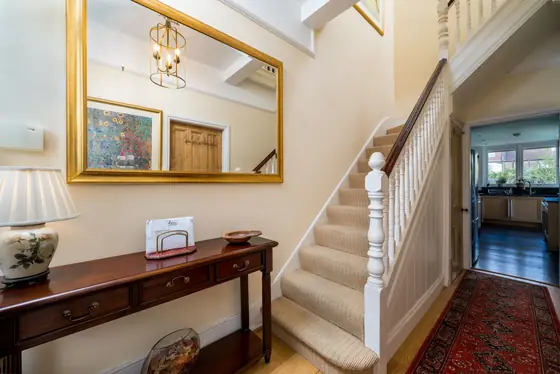
Staircases and doors in family houses
Over 80% of homes in the town are houses rather than flats, and almost all have a staircase. Treads and handrails get the most wear, so after staining we add a clear protective coat there, and keep a route up and down while it dries.
Panelled doors are stained in a set order, panels first and then rails and stiles, so wet edges don't leave dark overlaps. For the walls in the same rooms, see our interior decorating in Huntingdon.
Huntingdon at a glance
- 20 milesby road from our Landbeach base, about 24 minutesOSRM routing
- 8%of properties were built before 1919VOA Council Tax stock
- 3%date from 1919 to 1939VOA Council Tax stock
- 82%are houses rather than flatsCensus 2021
- 123listed buildingsHistoric England
- 56%of homes are owner-occupiedCensus 2021
How we approach woodwork staining & varnishing
We clean greasy door edges and dusty skirtings first, then sand everything to give a key. Old gloss is rubbed down so a new coat will grip, gaps along the wall line are filled, and bare pine primed to stop knots bleeding through. Stain is tested before it goes on everywhere, and painted work is lightly sanded between coats. The full method, products and FAQs are on our woodwork staining & varnishing page.