
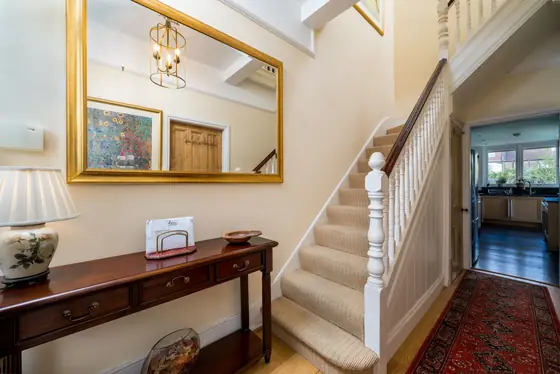
Staircases and doors
Stairs need planning because people still use them. We agree a route up and down while each coat dries, sand treads, handrails and spindles so stain takes evenly, then add a clear coat where wear is heaviest. One of our team videos shows Josh and Toby preparing a staircase before waxing.
Internal doors can be taken off their hinges or done in place with the floor protected, and handles and hinges are masked or removed. Panels go first, then rails and stiles, so wet edges never overlap.
Staining and varnishing period timber and listed interiors
The parish has 156 listed buildings, and older houses often have panelled doors, picture rails and deep skirtings. For listed buildings, check what the listing covers before stripping original finishes. Bare pine is primed with Zinsser to stop knots bleeding, as on the frames in our Farrow & Ball project.
St Neots at a glance
- 31 milesby road from our Landbeach base, about 39 minutesOSRM routing
- 6%of properties were built before 1919VOA Council Tax stock
- 4%date from 1919 to 1939VOA Council Tax stock
- 83%are houses rather than flatsCensus 2021
- 156listed buildingsHistoric England
- 66%of homes are owner-occupiedCensus 2021
How we approach woodwork staining & varnishing
We clean and key old gloss so new coats grip, fill gaps where skirtings meet the wall and sand out old drips. Before staining, timber is sanded evenly and the colour tested on a hidden spot. Coats are sanded lightly in between with Mirka dust-free sanders. Painted trim can match the walls, go darker, or stay white. The full method, products and FAQs are on our woodwork staining & varnishing page.