
Woodwork in Sandy homes
In the town's 1970s and 1990s houses, woodwork is often painted softwood that has yellowed over the years. A switch from gloss to satin or eggshell, or doors painted in the wall colour, can make a room feel calmer. Bare pine is primed with Zinsser first so knots don't bleed resin.
Old gloss is too shiny for a new coat to grip, so it's cleaned and lightly sanded before anything goes on. Doors are often greasy around the handles, and that gets washed off first too.
Stained staircases and period details
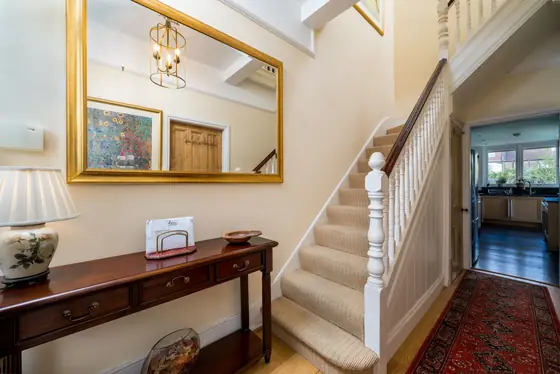
Staircases are the most visible woodwork in a house. We sand treads, spindles and handrails so stain takes evenly, keep a route up and down while it dries and finish wear areas with clear protection.
Sandy's older homes, around 670 built before 1919, often have panelled doors and picture rails. In a Victorian house in Histon, we made good and repainted rails, doors and skirtings in two bedrooms.
Sandy at a glance
- 28 milesby road from our Landbeach base, about 44 minutesOSRM routing
- 13%of properties were built before 1919VOA Council Tax stock
- 5%date from 1919 to 1939VOA Council Tax stock
- 89%are houses rather than flatsCensus 2021
- 51listed buildingsHistoric England
- 67%of homes are owner-occupiedCensus 2021
How we approach woodwork staining & varnishing
A sample of the stain goes on somewhere out of sight, such as the underside of a tread, and you sign off the colour before we carry on. On a four-panel door, we work the panels before the rails and stiles so wet edges never overlap. For painted woodwork, gaps along skirtings and architraves are filled, drips are sanded out, and we sand lightly between undercoat and top coats. The full method, products and FAQs are on our woodwork staining & varnishing page.