
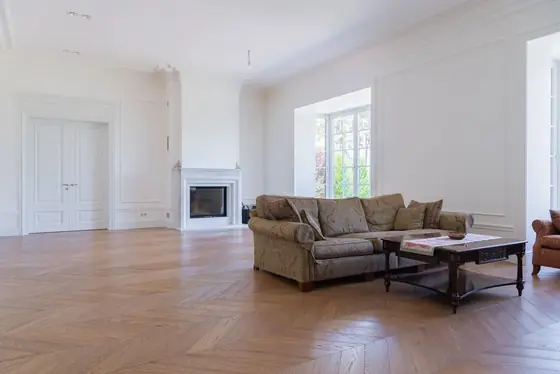
Fewer old floors, but worth finding
Only 11% of the village's homes are terraced, the house type most associated with long runs of original boards, so sanding is a smaller share of the work here than in a town of Victorian terraces. Detached cottages and older semis are where we'd expect to find boards, often under carpet or hardboard.
Newer houses can have solid or engineered timber floors that have gone grey or scratched. Chris checks the wear layer on engineered boards first, because it limits how much can be sanded away.
How Chris restores a floor
He sands across the main area with a belt sander and works the edges with an edging sander, then fills gaps with a mix of the floor's sawdust and Induro Morrells Mix & Fill. A last pass with a Mirka dust-free sander gets it ready for oil. The gold-oiled floor in Haddenham shows his work from start to finish.
Osmo Polyx oil comes clear or tinted, and it can be topped up later without sanding the whole floor again. Our main floor sanding page has more on finishes.
Isleham at a glance
- 21 milesby road from our Landbeach base, about 30 minutesOSRM routing
- 17%of properties were built before 1919VOA Council Tax stock
- 6%date from 1919 to 1939VOA Council Tax stock
- 11%are terracedCensus 2021
- 34listed buildingsHistoric England
- 1,047householdsCensus 2021
How we approach floor sanding
Furniture comes out, the room is sealed at the doors and any carpet gripper and staples are lifted. Protruding nails are punched down, loose boards fixed, and Chris sands through progressively finer grits. Oil is applied thinly, with drying time between coats. If the walls are being decorated too, the floor is done first. The full method, products and FAQs are on our floor sanding page.