
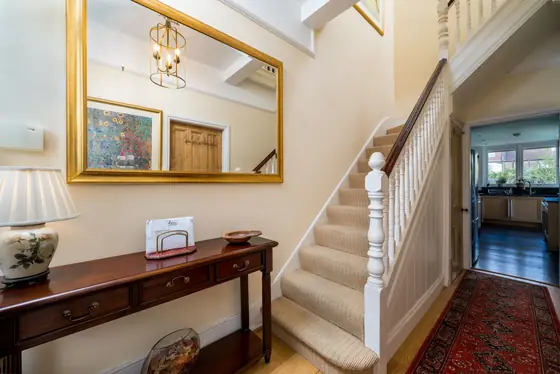
Staircases and doors in larger homes
A staircase is usually the biggest single piece of woodwork in the house. Restaining one means sanding every tread, riser and spindle evenly, or the colour takes patchily. We keep a route up and down while coats dry, and finish treads and handrails with a clear protective coat. Our staircase sanding and varnishing page explains the stages.
Internal doors can be stained to show the grain or painted. Panelled doors are worked in a set order so wet edges don't leave dark overlaps, and handles and hinges are removed or masked. There's more at internal door painting and spraying.
Older joinery and newer softwood
In Isleham's pre-1919 homes and listed buildings, original joinery is worth keeping. We fill and sand rather than strip unless there's a good reason to, and bare knotty pine is sealed with Zinsser so resin doesn't bleed through.
Around 30% of the village's homes were built since 2000, and their softwood skirtings and doors were often finished in a hurry. A light sand, a careful fill where skirting meets wall, and two coats of satin or eggshell make a clear difference.
Isleham at a glance
- 21 milesby road from our Landbeach base, about 30 minutesOSRM routing
- 17%of properties were built before 1919VOA Council Tax stock
- 6%date from 1919 to 1939VOA Council Tax stock
- 96%are houses rather than flatsCensus 2021
- 34listed buildingsHistoric England
- 79%of homes are owner-occupiedCensus 2021
How we approach woodwork staining & varnishing
We'd clean grease from door edges first, then key the existing gloss so the new coat grips. For stain, we test on a hidden spot, such as inside a cupboard door, and wait for your approval. Sanding is done with Mirka dust-free sanders, lightly between coats, and Osmo oil is used where beams or worktops need it. The full method, products and FAQs are on our woodwork staining & varnishing page.