
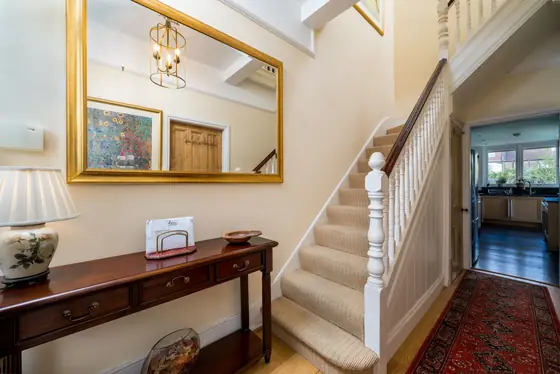
Mrs Turner's staircase and doors
Her review in full: “We are very pleased with the decorating and find, after inspection, all is very satisfactory. We found Valter and Denes very pleasant people to have in our home: exceptionally polite, hardworking and very punctual. Thank you very much for the amazing transformation, especially the staining on the staircase and doors.”
Staining a staircase means sanding every tread, riser, spindle and handrail evenly so the colour takes the same way everywhere, then sealing the parts that take wear with a clear coat. Our staircase painting page explains the options, from stain and varnish to paint.
Joinery across Fordham's homes
About 27% of homes in the Fordham area predate 1939, with panelled doors, deep skirtings and picture rails that have usually been painted many times. We fill dents and open joints, sand out old drips and prime any bare timber, using Zinsser on knotty pine so resin can't bleed through.
In the area's newer homes, the job is usually softwood doors and skirtings that need a smoother, harder finish. Gloss is still asked for, but satin and eggshell are more common now. Other homeowners' comments are collected on our reviews page.
Fordham at a glance
- 19 milesby road from our Landbeach base, about 24 minutesOSRM routing
- 18%of properties were built before 1919VOA Council Tax stock
- 9%date from 1919 to 1939VOA Council Tax stock
- 96%are houses rather than flatsCensus 2021
- 29listed buildingsHistoric England
- 67%of homes are owner-occupiedCensus 2021
How we approach woodwork staining & varnishing
We'd remove handles, mask hinges and clean grease off door edges before any sanding. Stains are tested on the underside of a tread or the back of a door for you to approve. Panelled doors are stained panels first, then rails and stiles. On stairs we leave a route open while coats dry, and finish with a protective coat. The full method, products and FAQs are on our woodwork staining & varnishing page.