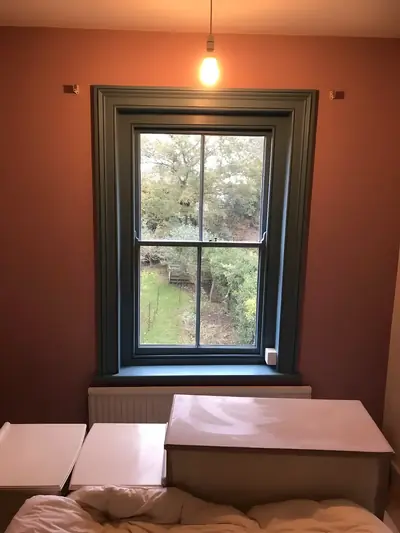
Windows on Fordham's listed and older houses
Listed buildings in Fordham range from the Grade I church of St Peter to houses such as 15 and 22 Mill Lane, both Grade II. Inside, colour is rarely an issue unless the building is listed.
Our part is the decorating: scraping, filling, priming and painting. Broken cords, rotten timber and loose beads go to our carpenter, and we schedule him first so the paint only goes on once.
Keeping sashes working
Paint that builds up in the runners is the usual reason a sash sticks. We keep coats thin where the sashes slide, work the windows up and down during the job and leave them eased each evening. A neat bead of paint onto the glass seals the putty. Our sash window restoration page goes into this in more depth.
Lower layers of paint on old windows may contain lead, so preparation is done with Mirka dust-free sanders and the room is sheeted and kept clean.
Mill Lane, Carter Street and the named houses: sash windows in Fordham
Three of Fordham's list entries are Mill Lane addresses, and Carter Street and River Lane have two each, but several others are houses known by name, such as Washington House and The Old Vicarage, both listed in 1984. An entry's name tells you nothing about its windows, so the only way to know whether a house has timber sashes, and what state they're in, is to look, and Graham does that window by window.
Original sashes belong mostly to pre-1919 houses, and on those the outside face does the hardest work. Bottom rails and sills catch standing water, so they get the most filling, priming and sealing, and the paint line is taken just onto the glass to seal the putty against rain. We handle the paintwork; where a sash needs new cords or timber, our carpenter does that first, on the same quotation.
Figures from Met Office 1991-2020 climate averages; Historic England's National Heritage List; Historic England conservation areas. Contains public sector information licensed under the Open Government Licence v3.0. © Crown Copyright 2026. Contains Ordnance Survey data © Crown copyright and database right 2026. Released under OGL. © Historic England and Local Planning Authorities 2026.
Fordham at a glance
- 10 milesfrom our Landbeach base in a straight line, about 24 minutes by roadOSRM routing
- 18%of properties were built before 1919 (Fordham and the surrounding area)VOA Council Tax stock
- 29listed buildingsHistoric England
- 1conservation areaHistoric England
- 15%are terracedCensus 2021
- 9%date from 1919 to 1939 (Fordham and the surrounding area)VOA Council Tax stock
Sources: Census 2021 for Fordham parish (ONS); Council Tax: stock of properties, 2026, for the statistical areas covering Fordham and the surrounding area; Historic England listed buildings; Historic England conservation areas; road distance by OSRM.
Listed buildings and conservation areas in Fordham
- Parish Church of St PetersGrade I listed
- 15, Mill LaneGrade II listed
- 22, Mill LaneGrade II listed
- FordhamConservation area
Sources: Historic England listed buildings; Historic England conservation areas.
Planning: check before you change a window
On a listed house in Fordham, ask East Cambridgeshire District Council before painting the outside of the sashes a new colour or changing the windows themselves. Its listed buildings page explains the council's position on repairs and maintenance, and for a house in the conservation area, the council's map shows the boundary.
Listed and historic buildings (council) · Fordham conservation area map (council)
How we approach sash window restoration
For a Fordham sash, Graham's quotation takes the windows one at a time, inside face and outside face, so the worst can be done first. Loose paint is scraped to a sound edge and sanded with Mirka dust-free sanders, which keeps dust from old layers that may contain lead out of the room. Open joints are filled, bare timber primed, and eggshell or satin laid on thinly where the sashes slide, with each one worked up and down so no face is missed.
Best time of year for the work
Outside faces of sashes need settled weather. At Brooms Barn, the Met Office station about 8 miles south-east of Fordham, March and April were the driest months in the 1991-2020 averages, at about 40 mm each, but one April in five brought more than 63 mm. Cambridge NIAB, about 13 miles west, recorded an air frost in April in 24 of its 30 years, so we'd usually leave outside faces until May and paint the inside faces in the colder months.