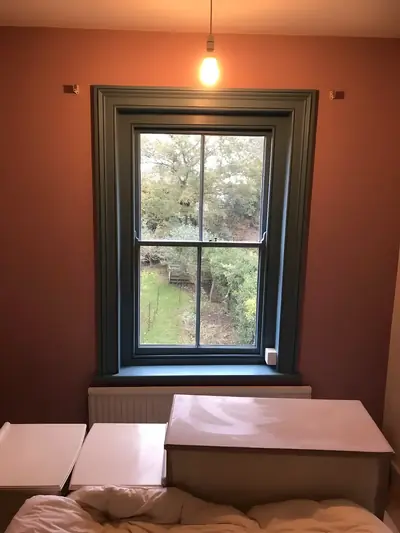
Period windows in High Town and North Street
Historic England lists 59 buildings in Burwell parish, from the Grade I Church of St Mary to 56 at Grade II. Off-white is the usual choice outside, while inside there's far more room for colour.
We should be clear about what we do. We prepare, repair-fill and paint, choosing primers to suit the timber. Broken cords, rotten timber or a sash that needs replacing goes to our carpenter, planned within the same job so you deal with one company.
Keeping sashes sound and sliding
Bottom rails and sills hold water, so they get the most attention. Mirka dust-free sanders matter here, because old layers on a sash may contain lead, so we scrape loose paint to a firm edge and sand with dust extraction running. Joints are filled and bare timber primed before eggshell or satin. Each step is listed on our main sash window restoration page.
A sash sticks when paint builds up where it slides, so those faces get the thinnest coats and each sash is moved while drying. On the glass, we carry a narrow line of paint over the putty to seal it.
Pre-1900 houses, North Street entries and Burwell's sash windows
Burwell's period houses are mostly older than Edwardian. Council Tax records count about 280 homes built before 1900, 9.8% of those with a known build date, but only about 70 from 1900 to 1918. Where original sash windows survive here, they're more likely to be Victorian or earlier than Edwardian.
The list entries cluster on the old streets. Nine of the entries named by house number are on North Street, among them 121, North Street and 125, North Street, and both of Burwell's conservation areas, Burwell High Town and Burwell North Street, were designated on 12 July 1974. A list entry's name tells you nothing about its windows, so the only way to know what a house has is to look at each one.
Being in a conservation area doesn't add much for most householders on its own: East Cambridgeshire District Council says it "does not impose many additional constraints for domestic property owners unless you are subject to an Article 4 direction". Burwell's conservation areas do have one, covering some homes, which is why the street-facing windows of those houses need checking first.
Figures from Valuation Office Agency Council Tax stock by build period; Met Office 1991-2020 climate averages; Historic England's National Heritage List; Historic England conservation areas. Contains public sector information licensed under the Open Government Licence v3.0. © Crown Copyright 2026. Contains Ordnance Survey data © Crown copyright and database right 2026. Released under OGL. © Historic England and Local Planning Authorities 2026.
Burwell at a glance
- 7 milesfrom our Landbeach base in a straight line, about 22 minutes by roadOSRM routing
- 12%of properties were built before 1919VOA Council Tax stock
- 59listed buildingsHistoric England
- 2conservation areasHistoric England
- 16%are terracedCensus 2021
- 6%date from 1919 to 1939VOA Council Tax stock
Sources: Census 2021 for Burwell parish (ONS); Council Tax: stock of properties, 2026; Historic England listed buildings; Historic England conservation areas; road distance by OSRM.
Listed buildings and conservation areas in Burwell
- Stevens MillGrade II* listed
- IsacsonsGrade II* listed
- Church of St MaryGrade I listed
- Burwell High TownConservation area
- Burwell North StreetConservation area
Sources: Historic England listed buildings; Historic England conservation areas.
Planning: check before you change a window
On a listed house, or a home in Burwell's Article 4 schedule, check with East Cambridgeshire District Council before painting the outside of sashes in a new colour or changing a window. Its listed buildings page covers when consent is needed for a listed building, and the Article 4 notice lists the homes in the schedule.
Listed buildings, East Cambridgeshire · Burwell Article 4 notice (PDF) · Burwell North Street conservation area page
How we approach sash window restoration
For a sash in one of Burwell's older houses, each window is looked at on its own, inside and out, and listed in the written quotation. Loose paint is scraped to a firm edge, the timber sanded with Mirka dust-free sanders, open joints and cracks filled, and bare wood primed before eggshell or satin goes on. The sashes are moved during the job so no face is missed, and any cord or rot repair is booked with our carpenter first.
Best time of year for the work
The outside faces of sashes are left for settled weather. At Cambridge NIAB, about 10 miles west of Burwell, air frost was recorded in April in 24 of the 30 years from 1991 to 2020 and in May in 9, but never from June to September, so outside faces are best planned for summer and early autumn.