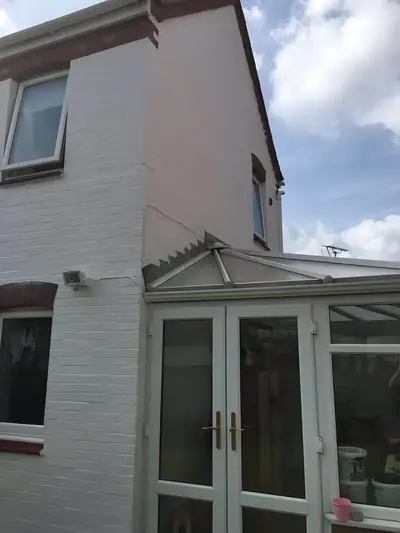
Exterior woodwork painting in Burwell
Timber outside fails at the joints and bottom edges first: the foot of a door, the sill and bottom rail of a window, the ends of a bargeboard. Once paint cracks, water gets behind it. We scrape back to a sound edge, sand, fill open joints with exterior filler and prime bare wood before the undercoat and top coats go on. Rot is cut out by our carpenter, not painted over.
Rooflines need the most access. On a detached house the fascias and soffits run all the way round, and we paint them from the same access as the gutters. There's more on our pages for soffit and fascia painting and painting exterior windows.
Clunch, brick and Burwell's conservation areas
Clunch, the soft chalk stone quarried in Burwell for 700 years, was used on many of the village's houses. Soft masonry needs to breathe, so we'd steer away from sealing coatings on it and talk through breathable options at the survey. Brick and render on newer houses take a good masonry paint once algae has been jet washed off with an anti-fungal wash.
The Burwell High Town and Burwell North Street conservation areas cover parts of the village, and 59 buildings in the parish are listed. We paint test patches so you can judge colours on your own wall in daylight.
Side walls, front elevations and Burwell's Article 4 direction
Burwell's houses have a lot of outside to look after. Of the 2,759 homes counted in the 2021 Census, 2,136 were detached or semi-detached, which is 77.4%, so most have at least one side wall as well as a front and a back. Side walls and gable ends can be the most exposed parts of a house and the hardest to reach, which is why they are often the first to need attention.
On some streets there's a planning question before the colour question. An Article 4 direction made on 12th November 2008 covers some homes in Burwell's conservation areas, on streets including The Causeway, High Street, North Street, Mill Lane and Silver Street. Its Schedule 1 lists "Class C The painting of the exterior of any building or wall", the schedule of properties sets which classes apply to each house, and, unless the direction says otherwise, the restrictions apply only to the parts of a house that front a highway, waterway or open space.
If you're choosing new colours for a house in either area, the council's appraisals of Burwell High Town and Burwell North Street, both from 2010, set out its view of each area's character and are worth a look before you settle on a colour card.
Figures from 2021 Census (ONS); Met Office 1991-2020 climate averages; Historic England conservation areas. Source: Office for National Statistics licensed under the Open Government Licence v.3.0. Contains public sector information licensed under the Open Government Licence v3.0. © Historic England and Local Planning Authorities 2026. Contains Ordnance Survey data © Crown copyright and database right 2026. Released under OGL.
Burwell at a glance
- 7 milesfrom our Landbeach base in a straight line, about 22 minutes by roadOSRM routing
- 93%are houses rather than flatsCensus 2021
- 50%of homes are detachedCensus 2021
- 12%of properties were built before 1919VOA Council Tax stock
- 2conservation areasHistoric England
- 16%were built 1945 to 1964VOA Council Tax stock
Sources: Census 2021 for Burwell parish (ONS); Council Tax: stock of properties, 2026; Historic England conservation areas; road distance by OSRM.
Listed buildings and conservation areas in Burwell
- Stevens MillGrade II* listed
- IsacsonsGrade II* listed
- Church of St MaryGrade I listed
- Burwell High TownConservation area
- Burwell North StreetConservation area
Sources: Historic England listed buildings; Historic England conservation areas.
Planning: check before you change colours
If your house is listed, or is in the Article 4 schedule and faces a highway, waterway or open space, check with East Cambridgeshire District Council before changing its outside colours. The council's general guidance is that "repairs and maintenance generally do not require planning permission", so if you're unsure whether repainting in the existing colour counts, ask them.
Burwell Article 4 notice (PDF) · East Cambridgeshire conservation areas page · Listed buildings, East Cambridgeshire
How we approach exterior painting
Graham walks round a Burwell house elevation by elevation, side walls included, and notes whether each one faces the street. Walls and woodwork are jet washed with an anti-fungal wash and left to dry; failed paint is scraped and sanded back to a sound edge, cracks and open joints are filled, and bare timber is primed. Masonry paint goes on brick and render, and exterior-grade satin or gloss on fascias, soffits, windows and doors. Each step and the products we use are explained on our exterior painting page, with answers to common questions.
Best time of year for the work
Outside work is planned for the frost-free part of the year. At the Met Office's Cambridge NIAB station, about 10 miles west of Burwell, the 1991-2020 averages show no air frost from June to September and roughly seven to nine days with rain in each month from May to September. October is the wettest month there, at 58.7 mm, so we aim to finish exterior jobs before it arrives.