
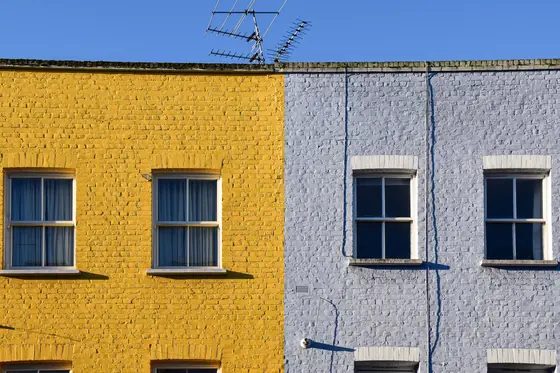
Terraces, semis and detached houses
Semi-detached and detached houses together make up about 42% of homes, and those have side walls and gables that take more weather. On a terrace the work is mostly the front and rear elevations, the windows and the roofline, but access can be tighter, particularly where there's no side passage to the back.
Graham surveys every elevation first, noting cracked masonry, blown render and soft timber. Repairs go into the written quotation before any paint is opened, and larger timber or masonry repairs go to our carpenter and master builder.
Painting in the conservation area
Part of the town is covered by the Newmarket conservation area, and 109 buildings in the parish are listed. If your house is in either, speak to West Suffolk Council before changing an exterior colour or painting bare brick. We'll paint test patches so you can compare shades on the wall itself.
Where walls carry algae or mould, we use an anti-fungal jet wash, as on this Cambridge exterior, and let the masonry dry before painting.
Newmarket at a glance
- 15 milesby road from our Landbeach base, about 21 minutesOSRM routing
- 72%are houses rather than flatsCensus 2021
- 16%of homes are detachedCensus 2021
- 20%of properties were built before 1919VOA Council Tax stock
- 1conservation arealocal council
- 14%were built 1945 to 1964VOA Council Tax stock
How we approach exterior painting
For a Victorian terrace we'd scrape and sand failed paint from window frames and sills, prime bare timber and fill cracks in render with exterior filler. Walls get breathable masonry paint, and gutters and fascias are done from the same access. Exterior work is planned for the drier months and paused if rain is due. The full method, products and FAQs are on our exterior painting page.