
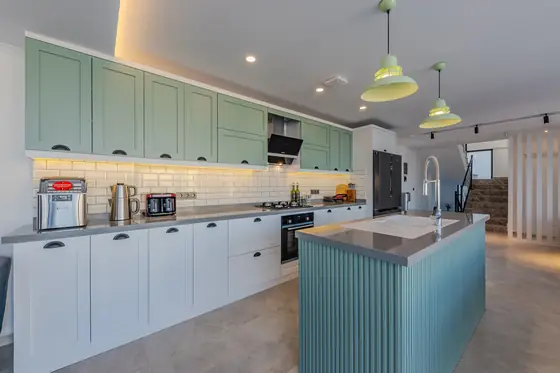
Owners keeping a kitchen that works
Just under half of Newmarket households own their home, about 25% outright and 23% with a mortgage. For those owners, painting the units avoids ripping out worktops, moving plumbing or waiting on a fitter. Graham checks what the doors are made of at the visit, because timber and MDF take paint well while some foil-wrapped finishes don't.
In a rented flat, painted units can refresh a kitchen between tenants without the cost of replacement, provided the doors are sound.
Preparation, spraying and finish
The first day is degreasing and sanding. Doors carry grease around every handle and near the hob, and no paint bonds to that. After sanding with Mirka dust-free sanders, we prime with Zinsser and apply a hard-wearing eggshell or satin.
On long runs of flat doors, our Graco Ultra cordless sprayer gives a brush-free finish. In a compact kitchen with Shaker doors, a brush and roller is often quicker once masking is counted. Our kitchen unit painting page explains the trade-off in more detail.
Newmarket at a glance
- 15 milesby road from our Landbeach base, about 21 minutesOSRM routing
- 48%of homes are owner-occupiedCensus 2021
- 23%of households own with a mortgageCensus 2021
- 15%were built 1983 to 1999VOA Council Tax stock
- 17%were built since 2000VOA Council Tax stock
- 72%are houses rather than flatsCensus 2021
How we approach kitchen cabinet painting
We'd label and remove the doors where that helps, degrease every surface, sand and fill chips, then prime to suit the existing finish. Worktops, tiles and appliances are masked before spraying or brushing. Two top coats of a woodwork paint such as Tikkurila follow, and the sink and fridge stay usable during the job. The full method, products and FAQs are on our kitchen cabinet painting page.