Textured ceilings in post-war housing
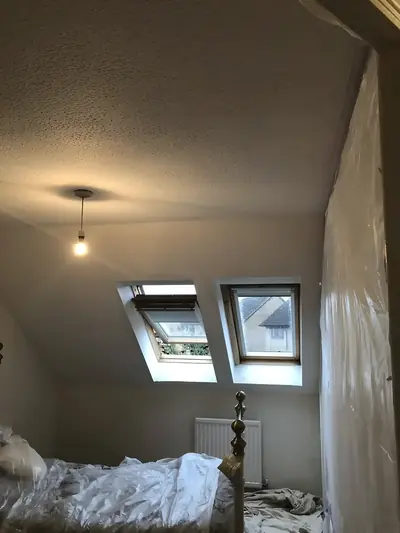
The 1973 to 1982 band is the biggest single period here, at around 1,490 properties. Artex and similar coatings from those decades make a room look dated and are hard to paint neatly. Lewis, our plasterer, or the master plasterer we work with skims over them to give a smooth, modern ceiling.
After the plaster dries, our decorators sand it with Mirka dust-free sanders and apply a mist coat, which soaks in and shows up any imperfections before the finish coats go on.
Victorian walls and making good
Newmarket also has a large pre-1900 stock, about 1,480 homes. Stripping old paper in those houses can expose lath and plaster or loose patches. We'll show you what we find and agree any extra before plastering starts, as we did in a Cambridge bedroom with tired lath and plaster.
Not every older wall needs a skim. Sometimes filling and lining paper are enough, and Graham decides which at the survey.
Artex-era ceilings and older lime walls in Newmarket
Council Tax records show about 520 Newmarket homes built from 1945 to 1954, 630 from 1955 to 1964 and 1,180 from 1965 to 1972. Textured Artex coatings were common on ceilings of that period, and skimming over them is the usual way to get a smooth ceiling that takes paint cleanly.
Older houses need a different approach. Homes built before 1919 usually have lime plaster on brick or lath, softer and less even than modern plaster, and stripping old paper can show loose or hollow patches. Some of those walls only need filling and lining paper rather than a skim, and that call is made at Graham's survey; where plaster has come away from its backing, Lewis or our master plasterer makes it good first.
Damp needs ruling out before any of this. Neither plaster nor paint holds on a wall that stays wet, so Graham looks for the cause of any staining at the survey, and once it has been fixed, a water-stained ceiling is sealed with a Zinsser stain block so the mark doesn't bleed through the new paint.
Figures from 2021 Census (ONS); Valuation Office Agency Council Tax stock by build period. Source: Office for National Statistics licensed under the Open Government Licence v.3.0. Contains public sector information licensed under the Open Government Licence v3.0.
Newmarket at a glance
- 10 milesfrom our Landbeach base in a straight line, about 21 minutes by roadOSRM routing
- 14%were built 1945 to 1964VOA Council Tax stock
- 31%were built 1965 to 1982VOA Council Tax stock
- 20%of properties were built before 1919VOA Council Tax stock
- 8,178householdsCensus 2021
- 4%date from 1919 to 1939VOA Council Tax stock
Sources: Census 2021 for Newmarket parish (ONS); Council Tax: stock of properties, 2026; road distance by OSRM.
Listed buildings: check before plastering
If your Newmarket home is listed, ask West Suffolk Council before old lime plaster, lath or a ceiling is taken down or skimmed over. Listed Building Consent is something the council says any proposed works to a listed building need, and it publishes a leaflet on maintaining historic and listed buildings.
Listed buildings and consent (West Suffolk Council) · Maintaining historic and listed buildings (PDF)
How we approach plastering
In a Newmarket house from the 1950s to the early 1970s, we'd sheet the floor and furniture, take down light fittings and prepare the textured surface so the skim bonds. After Lewis or our master plasterer has skimmed it and the plaster has dried right through, it's sanded with Mirka dust-free sanders and given a mist coat, which shows up any marks before two full coats of your colour. On older walls, the skim waits until loose areas have been made good. There is more on preparation, products and common questions on our main plastering page.
One check comes before any Artex is touched. According to the Health and Safety Executive, textured coatings in homes built or refurbished before 2000 may contain asbestos, so the ceiling should be sampled and tested before it is sanded, scraped or drilled, and if the test finds asbestos, disturbing it is work for an asbestos specialist, not for us. More on skimming over Artex and on plastering over Artex safely.