Yes, you can plaster over Artex. If the coating is firmly stuck, dry and undamaged, a plasterer can skim straight over it to give a smooth ceiling, or fix new plasterboard over it and skim that. The one step you should not skip is finding out whether it contains asbestos, because the usual preparation of scraping off the peaks is exactly what HSE says not to do to coatings that might.
Can you plaster over Artex? The conditions that matter
Skimming over Artex works when the plaster has something sound to hold on to. Before anything else, a plasterer will check:
- Adhesion. The coating should not be flaking, bubbling or coming away when pressed. Loose Artex under new plaster will fail with it.
- Damp and water damage. Stains or soft patches need the cause fixing first, and the stain sealing before decoration.
- Cracks and movement. Fine cracks are common. Long cracks, sagging or a ceiling that moves when pressed suggest a problem with the ceiling itself, and overboarding may be the safer option.
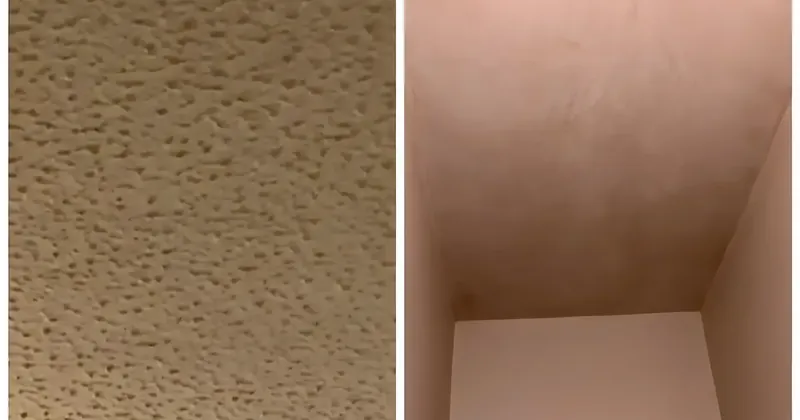
- Depth of texture. Shallow stipples are easier to fill than deep swirls or peaks, which may need more plaster or a different approach.
If all of that checks out, skimming is usually quicker and far less disruptive than taking a ceiling down.
First, find out whether the Artex contains asbestos
HSE's position is that asbestos may be present in any home "built or refurbished before the year 2000", and it names textured decorative coatings, commonly called Artex, among the materials that can still contain it. You cannot rule it out from the age of the paint on top or how the ceiling looks.
What HSE does say clearly is what not to do. Its task sheet for working on textured coatings carries this caution: "Never scrape through or sand down textured coatings or stripped surfaces. Don't use power tools to cut through textured coatings." That matters because many online guides tell you to knock off the high points or sand the surface before skimming.
So before skimming over Artex in an older house:
- Get a sample analysed. HSE recommends the sample is taken by someone fully trained, such as a laboratory analyst or a competent asbestos surveyor, and the analysis must be done by a laboratory accredited to ISO/IEC 17025. In Great Britain, accredited labs are listed by UKAS. See HSE's page on sourcing asbestos analysts and surveyors.
- If you do not test, assume it is asbestos. HSE's advice to anyone who comes across potential asbestos is to "confirm what it is or assume it is asbestos". Then choose a method that avoids scraping, sanding or cutting the coating.
- Tell your plasterer the result before they quote, so the method fits.
If the result is negative, the plasterer has more freedom to prepare the surface, provided the sample is representative of the whole ceiling. If it is positive, the guidance differs on what comes next.
Skimming over Artex: how it is usually done
Methods vary between plasterers, but on a sound, asbestos-free ceiling the general trade approach is:
- Protect the room. Clear or sheet the furniture and floor, and take down light fittings and smoke alarms.
- Deal with the high spots. Only where the coating has tested clear of asbestos. Otherwise the plaster is built up over the texture instead.
- Apply a bonding agent. Painted Artex is smooth and does not absorb much, so plaster needs help to grip. British Gypsum describes its Thistle Bond-it as a bonding agent "for smooth and/or low suction backgrounds" and lists re-skimming among its uses. Its data sheet says the room and ceiling must stay above 5°C until it is fully dry.
- Fill the texture, then skim. Deep patterns often need a first coat to fill the hollows before the finishing coat goes on.
- Let it dry out fully before any paint goes on.
Then the decorating. New plaster is porous, so we seal it with a mist coat of thinned emulsion, which also shows up any small marks to fill before the final two coats. Our plastering page explains that sequence in more detail.
Overboarding: when it is the better choice
Overboarding means fixing new plasterboard to the joists through the existing ceiling, then skimming the board. It suits ceilings that are cracked, uneven or not well bonded, and it avoids disturbing most of the old surface.
It is not completely hands-off. Every screw goes through the coating, and HSE has a separate task sheet for inserting and removing screws through textured coatings. It covers protecting the room, painting sealant around each hole and cleaning up with a Class H vacuum, and it even asks whether strong adhesive could be used instead of screws. If your Artex may contain asbestos, ask how the plasterer plans to fix the boards.
The other trade-off is height. You lose the thickness of the board and the skim, and light fittings, coving and cornices need working around.
Skim, overboard or remove: a comparison
| Skim over the Artex | Overboard and skim | Remove the Artex | |
|---|---|---|---|
| Best for | Sound, well-bonded coatings | Cracked, uneven or poorly bonded ceilings | Coatings that have failed, or where the original surface is wanted |
| Disturbance of the coating | Low, if the surface is not scraped or sanded | Screw holes only | High |
| Ceiling height | Almost unchanged | Slightly lower | Unchanged |
| Asbestos considerations | Test first; no scraping or sanding unless clear | Controls for screw fixing | HSE rules depend on area and method |
How to remove Artex from a ceiling, and why most people do not
If the coating has tested negative, it can be softened and stripped, though it is slow, wet and messy, and the ceiling usually needs skimming afterwards anyway.
If it contains asbestos, or might, removal is where the rules tighten. HSE's guidance, checked 2026-10-23:
- Removing a small area, around 1 m², using steam or gel in preparation for other maintenance, such as fitting a light, is non-licensed work, described in HSE task sheet a28 for trained workers.
- Larger-scale removal using steam or gel is still non-licensed, but becomes notifiable non-licensed work, which brings extra legal duties for the contractor.
- Removal by energetic methods such as wet abrasive blasting, or of coatings on asbestos insulating board, needs an HSE-licensed contractor.
The Asbestos Removal Contractors Association's guidance goes further, saying removal of asbestos-containing textured coatings "is best carried out by an HSE licensed asbestos removal contractor". And HSE's advice to homeowners is not to repair or remove asbestos materials yourself without training. See HSE's asbestos FAQs and locations and actions page.
For most dated Artex ceilings, that is why skimming or overboarding is the usual choice.
If the Artex does contain asbestos
The guidance conflicts:
- HSE advises that asbestos materials in good condition are often best left where they are.
- Lambeth Council's guide for its tenants says Artex that is completely sealed and undamaged can be painted over with a soft roller and normal emulsion.
- ARCA lists sealing or encapsulating textured coatings in good condition as non-licensed work, which still has to be done by trained people under the asbestos regulations.
- Some asbestos consultants, such as Summit Environmental, say plastering over asbestos-containing Artex is not recommended.
Our reading is that leaving it, painting it or covering it without breaking the surface are the low-disturbance options, and anything involving scraping, sanding or removal needs specialist advice. If you are in any doubt, speak to a competent asbestos surveyor before booking a plasterer.
What we have done on Artex ceilings
We have skimmed over Artex on documented jobs in and around Cambridge. On one job, a client fed up with dated Artex ceilings had them skimmed smooth by our plasterer Lewis, and commented on how clean and tidy he left the house. You can see the result in our Artex skimming case study. On a whole-house renovation, two of our plasterers skimmed the old Artex ceilings while our decorators prepared walls and hung new coving.
On a separate job, a Checkatrade customer in CB22, whose job was listed as "Re-skimmed cracked ceiling (covering artex)", wrote:
Very quick and neat work. Very professional. Time-keeping was perfect.
When to call a professional, and when DIY is fine
Painting over sound, undamaged Artex is a reasonable DIY job. Use a roller, do not sand it first, and leave any damaged patches alone until you know what they are.
Skimming a ceiling is skilled work, and a poor skim over texture shows every ripple once painted. Call a plasterer when:
- you want a smooth ceiling rather than painted texture
- the coating is cracked, damaged or coming away
- you are planning new lights, coving or a ceiling rose that means drilling through it
Before your visit, it helps to know roughly when the house was built and whether the ceiling has been tested. Graham will look at the ceiling, talk you through skimming or overboarding, and put the plastering and decorating into one written quotation. Our guide to preparing for a decorator covers what to sort out before the team arrives.
If you are ready to get rid of a dated Artex ceiling, get in touch to arrange a free visit and quotation for plastering and Artex skimming.
Questions people also ask
Is it better to skim or remove Artex?
For most sound ceilings, skimming is quicker, less messy and avoids disturbing the coating. Removal is a much bigger job, and if the Artex contains asbestos it brings legal controls that depend on the area and method.
Will plaster stick to painted Artex?
Yes, if the surface is sound and prepared. Painted Artex is smooth and low suction, so plasterers usually apply a bonding agent first. British Gypsum's Thistle Bond-it is made for smooth or low-suction backgrounds and re-skimming.
Can you skim over Artex that contains asbestos?
Guidance differs. HSE says never to scrape or sand textured coatings. ARCA treats sealing or encapsulating coatings in good condition as non-licensed work for trained people; it does not say whether skimming counts. Some consultants advise against plastering over it. Get advice from a competent asbestos surveyor first.
How long after skimming can I paint the ceiling?
Only once the plaster has dried out fully, which depends on thickness, temperature and ventilation. A mist coat of thinned emulsion goes on first, then the finish coats.
Do I need to test Artex before plastering over it?
If the house was built or refurbished before 2000, testing is the sensible step, because HSE says asbestos may be present. If you choose not to test, HSE's advice is to assume it is asbestos, so avoid any method that scrapes, sands or cuts the coating.
Talk to Graham about your plastering
Graham visits free of charge, looks at the job with you and sends a detailed written quotation. You don't pay until you're happy with the finished work. We work across Cambridge and the towns and villages around it: find your area.
Sources
- Asbestos FAQs, Health and Safety Executive (checked 23 October 2026)
- Locations of asbestos and taking the right action, Health and Safety Executive (checked 23 October 2026)
- Asbestos essentials a28: Removing textured coating from a small area, for example 1m2, Health and Safety Executive (checked 23 October 2026)
- Asbestos essentials a27: Inserting and removing screws through textured coatings, Health and Safety Executive (checked 23 October 2026)
- Sourcing professional advice and services on asbestos issues, Health and Safety Executive (checked 23 October 2026)
- GN005: Guidance for working with textured decorative coatings containing asbestos, Asbestos Removal Contractors Association (checked 23 October 2026)
- Asbestos management: textured decorative coatings in your home, Lambeth Council (checked 23 October 2026)
- Thistle Bond-it product data sheet (2 August 2021), British Gypsum (copy hosted by Roof Giant) (checked 23 October 2026)
- Help with textured finishes and artex: can you skim and plaster over artex?, Summit Environmental (checked 23 October 2026)
Written by Graham Halpenny Decorators. Third-party prices, product data and regulations are credited to their source with the date we checked them; they are not our prices. Spotted something out of date? Let us know.