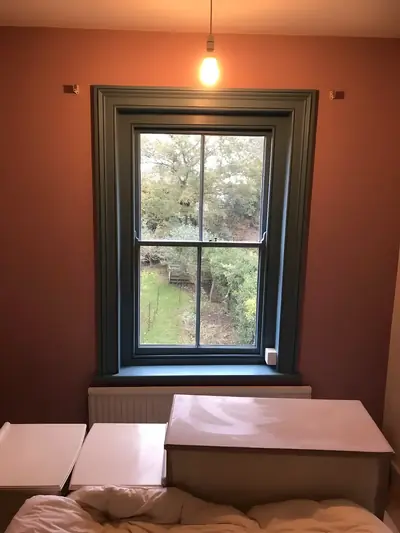
Period windows and listed buildings
Historic England lists 109 buildings in the parish, including Cleveland House and Palace House, both Grade II*.
We handle the decorative side of sash care: scraping back to sound paint, sanding with dust-extracting sanders, filling open joints, priming bare timber and finishing. Where a sash needs new cords or replacement timber, our carpenter does that work before we paint.
Windows facing the weather
The windows that take the most rain and sun need the most attention, and Graham's quotation lists each window separately so you can tackle the worst first. Sills and bottom rails get extra care because they catch standing water.
We keep paint thin on the faces that slide so the sashes still open. More detail is on our sash window restoration page, and woodwork inside the room can be done at the same time under woodwork painting and staining.
Sash windows in Newmarket's pre-1900 houses
Newmarket's period housing is mostly older than the Edwardian era. Council Tax records put 17.4% of homes before 1900 but only 2.1% between 1900 and 1918, so any original timber sashes are most likely to be on houses built before 1900.
Some of those older buildings are listed. Historic England's entries for the parish include Havelock House and Windsor House, both Grade II and listed in 1984, and West Suffolk Council publishes a leaflet on windows in historic buildings. On a listed house, the consent note on this page explains who to ask before a colour or a pane changes.
If yours is one of the 62.8% of Newmarket homes built from 1965 on, its windows are more likely to be casements than sashes. Timber casements on a post-war house still get the same careful preparation as a sash, window by window.
Figures from Valuation Office Agency Council Tax stock by build period; Met Office 1991-2020 climate averages; Historic England's National Heritage List; Historic England conservation areas. Contains public sector information licensed under the Open Government Licence v3.0. © Crown Copyright 2026. Contains Ordnance Survey data © Crown copyright and database right 2026. Released under OGL. © Historic England and Local Planning Authorities 2026.
Newmarket at a glance
- 10 milesfrom our Landbeach base in a straight line, about 21 minutes by roadOSRM routing
- 20%of properties were built before 1919VOA Council Tax stock
- 109listed buildingsHistoric England
- 1conservation areaHistoric England
- 30%are terracedCensus 2021
- 4%date from 1919 to 1939VOA Council Tax stock
Sources: Census 2021 for Newmarket parish (ONS); Council Tax: stock of properties, 2026; Historic England listed buildings; Historic England conservation areas; road distance by OSRM.
Listed buildings and conservation areas in Newmarket
- Palace House and entrance stepsGrade II* listed
- Cleveland HouseGrade II* listed
- Church of St MaryGrade II* listed
- NewmarketConservation area
Sources: Historic England listed buildings; Historic England conservation areas.
Planning: check before you change a window
If your sashes belong to a listed building, speak to West Suffolk Council before the work is booked, including any change of colour or glazing, since works to a listed building need Listed Building Consent according to the council's listed buildings page. For homes in the Newmarket conservation area, the council's windows leaflet and conservation area map are the places to start.
Windows in historic buildings (PDF) · Listed buildings and consent (West Suffolk Council) · Newmarket conservation area map (West Suffolk Council)
How we approach sash window restoration
On a Newmarket sash we'd note each window separately, marking any that need our carpenter for broken cords or soft timber before paint is touched. Loose paint is scraped to a firm edge and sanded with Mirka dust-free sanders, since older layers can contain lead, open joints are filled, and bare wood is primed with Zinsser before undercoat and an eggshell or satin top coat. Each sash is moved through its full travel between coats so nothing sets shut.
Best time of year for the work
Brooms Barn, the Met Office station about 7 miles east of Newmarket, averages 2.3 days of air frost in April and 0.5 days in October over 1991-2020, and at Cambridge NIAB, about 12.9 miles west, April brought at least one air frost in 24 of the 30 years. Outside faces are planned for late spring to early autumn on that basis, while inside faces can be painted at other times of year.