
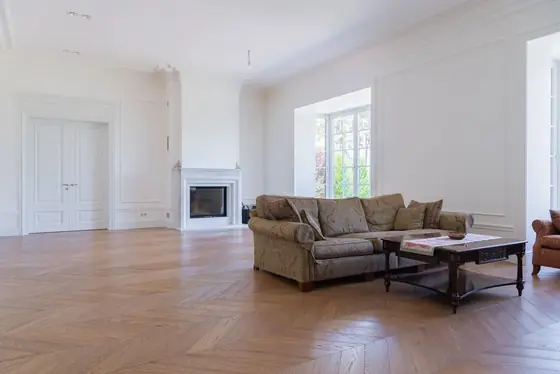
Original boards in older terraces
Victorian and Edwardian floors were usually laid in softwood boards that sand back well. Expect gaps between boards, staining where a rug once sat and patches of later repair. Most of these blend in once the floor is sanded and oiled, and anything that won't is pointed out before quoting.
Interwar homes are scarce here, about 4% of the stock, so most floors outside the pre-1919 houses will be from the 1950s onwards. Those may be chipboard, engineered or laminate, which Chris can identify quickly.
How Chris restores a floor
Chris, our wooden floor specialist, uses a belt sander for the main area and an edging sander along the skirtings. Small gaps are filled with the floor's own sawdust mixed with Induro Morrells Mix & Fill, then the floor is smoothed with a Mirka dust-free sander and finished in Osmo oil.
The Haddenham floor restoration shows a full job, finished in Polyx tint oil in Gold with flecks of 24-carat gold.
Newmarket at a glance
- 15 milesby road from our Landbeach base, about 21 minutesOSRM routing
- 20%of properties were built before 1919VOA Council Tax stock
- 4%date from 1919 to 1939VOA Council Tax stock
- 30%are terracedCensus 2021
- 109listed buildingsHistoric England
- 8,178householdsCensus 2021
How we approach floor sanding
In a terrace we'd typically sand the front room, back room and hall, sealing doorways against dust. Before the sander goes on, Chris fixes down any loose boards and punches proud nail heads out of the way. After filling and final smoothing, thin coats of clear or tinted Osmo Polyx go on, with drying time between them. Furniture returns once the last coat is dry. The full method, products and FAQs are on our floor sanding page.