Listed homes and the Isleham conservation area
Grade II buildings in the village include 1 Mill Street and 41 Mill Street, and Isleham Hall on West Street dates from the 16th century. Not every older window is a sash, and we paint casements too.
We keep the work decorative. Rotten sills, split rails and broken cords are passed to our carpenter, and his repairs are planned into the same job so paint doesn't go on before the joinery is right.
Preparing sashes properly
Older windows can hold many layers of paint, some of it lead-based, so we sand with Mirka dust-free sanders rather than dry-scraping heavily indoors. Bare timber is primed before undercoat, cracks and open joints are filled, and loose putty is flagged for repair. Our sash window page covers the full sequence.
Paint is kept thin where sashes slide past each other, and each window is moved during the job so it doesn't set shut. A fine line of paint onto the glass stops rain getting behind the putty.
Timber windows in Isleham's oldest houses and listed buildings
No dataset we hold counts sash windows, so Historic England's list is the best local guide to where period joinery is protected. Both of the parish's Grade I entries are churches, the Church of St Andrew and the Priory Church of St Margaret of Antioch, and none is Grade II*, so every listed house in Isleham is Grade II. Half of the 32 Grade II entries are named by house number, among them 10 Little London Lane.
Not every entry is a simple house number. Inisfail is listed by name, and 12 West Street is listed together with the former barn adjoining it to the west, so a window on an outbuilding can fall under the same entry. If you're unsure, search the list by your address and your house name before outside work on the windows is booked. Unlisted older houses often have timber windows too, and they get the same preparation.
Figures from Met Office 1991-2020 climate averages; Historic England's National Heritage List; Historic England conservation areas. Contains public sector information licensed under the Open Government Licence v3.0. © Crown Copyright 2026. Contains Ordnance Survey data © Crown copyright and database right 2026. Released under OGL. © Historic England and Local Planning Authorities 2026.
Isleham at a glance
- 11 milesfrom our Landbeach base in a straight line, about 30 minutes by roadOSRM routing
- 17%of properties were built before 1919VOA Council Tax stock
- 34listed buildingsHistoric England
- 1conservation areaHistoric England
- 11%are terracedCensus 2021
- 6%date from 1919 to 1939VOA Council Tax stock
Sources: Census 2021 for Isleham parish (ONS); Council Tax: stock of properties, 2026; Historic England listed buildings; Historic England conservation areas; road distance by OSRM.
Listed buildings and conservation areas in Isleham
- Church of St AndrewGrade I listed
- 1, Mill StreetGrade II listed
- 41, Mill StreetGrade II listed
- IslehamConservation area
Sources: Historic England listed buildings; Historic England conservation areas.
Planning: check before you change a window
If your Isleham house is listed, talk to East Cambridgeshire District Council before a sash is replaced or altered, or its outside is painted a new colour. Inside the Isleham conservation area, it's worth asking too before windows on the street side change. The council's conservation page says its Article 4 Directions only affect elevations fronting a public highway or open space, and it names Burwell, Ely and Soham, not Isleham, as the areas that have them (checked October 2026).
East Cambridgeshire listed buildings page · Isleham conservation area map · East Cambridgeshire conservation areas and Article 4
How we approach sash window restoration
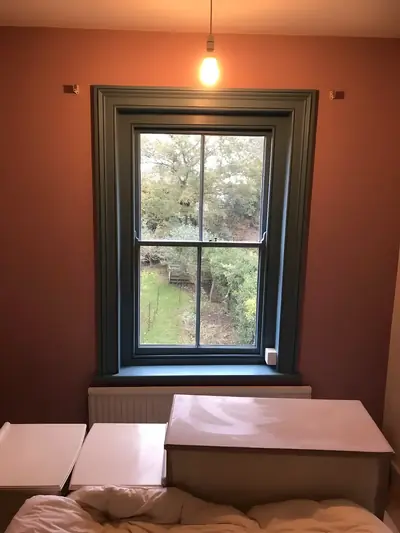
Where an Isleham window has worn back to bare timber, it's primed with Zinsser before anything else, then built up with an eggshell undercoat and two finish coats, the system used on every bare pine frame in a Farrow & Ball redecoration in Cambridge, finished in Elephant's Breath. Paint is kept thin on the edges that slide, the sashes are worked up and down as it dries, and a tester patch on one frame shows the colour before the rest are done.
Best time of year for the work
Air frost averages less than one day a month from May to October at Brooms Barn, the Met Office station about 9 miles south-east of Isleham, on the 1991-2020 figures. Cambridge NIAB's monthly records still show at least one air frost in May in 9 of those 30 years, and the same count for October, so the outside faces of sashes are planned for June to September where possible, while the inside faces can be done in any month.