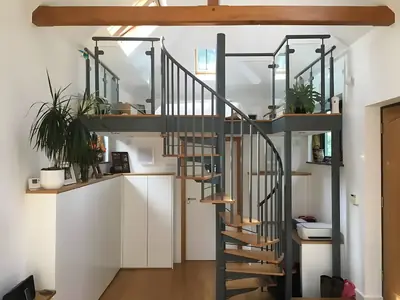
Staining a Burwell staircase
In nearby Fordham, Mrs M Turner thanked Valter and Denes for the staining on her staircase and doors. A job like that starts with sanding the timber evenly, because patchy sanding shows as pale areas under stain. We test the colour on a hidden spot, then varnish the treads and handrail where they take the most wear.
Our staircase painting page covers painted stairs, and we can keep one side usable while the other dries.
Older joinery and Burwell's listed buildings
About 510 homes in the village predate 1939, by Council Tax records, and those tend to have deeper skirtings, panelled doors and more layers of old paint. We sand back drips and runs, fill dents and prime bare wood, using Zinsser on knotty pine to stop resin bleeding through.
Beams and other bare timber can be oiled with Osmo, which soaks in and can be topped up later.
Farmhouses, barns and chapels on Burwell's list, and its 1990s staircases
Burwell's list entries include five farmhouses, among them Parsonage Farmhouse, listed in 1951, and Tunbridge Farmhouse, as well as four barns and three churches and chapels. Entry names say nothing about what's inside, but joinery in a listed building, from staircases to doors and panelling, can be old enough to deserve real care before anyone sands, strips or stains it.
Most Burwell woodwork is far newer. The single biggest band in Council Tax records is 1993 to 1999, holding 16.8% of the homes whose build date is known. For a staircase of that age the choice is usually between refreshing the varnish, staining it darker or painting part of it, and a painted riser hides scuffs from shoes better than bare timber.
There's usually plenty of it. At the 2021 Census, 68.2% of Burwell households had three or more bedrooms, so a typical landing has several doors and frames and a long run of skirting, and those often make up the bulk of a woodwork job.
Figures from 2021 Census (ONS); Valuation Office Agency Council Tax stock by build period; Historic England's National Heritage List. Source: Office for National Statistics licensed under the Open Government Licence v.3.0. Contains public sector information licensed under the Open Government Licence v3.0. © Crown Copyright 2026. Contains Ordnance Survey data © Crown copyright and database right 2026. Released under OGL.
Burwell at a glance
- 7 milesfrom our Landbeach base in a straight line, about 22 minutes by roadOSRM routing
- 12%of properties were built before 1919VOA Council Tax stock
- 6%date from 1919 to 1939VOA Council Tax stock
- 93%are houses rather than flatsCensus 2021
- 59listed buildingsHistoric England
- 76%of homes are owner-occupiedCensus 2021
Sources: Census 2021 for Burwell parish (ONS); Council Tax: stock of properties, 2026; Historic England listed buildings; road distance by OSRM.
Listed buildings and conservation areas in Burwell
- Stevens MillGrade II* listed
- IsacsonsGrade II* listed
- Church of St MaryGrade I listed
- Burwell High TownConservation area
- Burwell North StreetConservation area
Sources: Historic England listed buildings; Historic England conservation areas.
Listed buildings: check before changing original woodwork
For a listed house, ask East Cambridgeshire District Council before original joinery is stripped, replaced or given a different finish. The front door of a home in Burwell's Article 4 schedule is worth checking too before a colour change, as the direction can include painting the outside of elevations that face a highway, waterway or open space.
Listed buildings, East Cambridgeshire · Burwell Article 4 notice (PDF)
How we approach woodwork staining & varnishing
We'd start a Burwell woodwork job by finding out what's on the timber now: varnish, stain, paint or a mixture. Greasy door edges and handle areas are cleaned, old gloss keyed and dents filled, and bare pine is primed with Zinsser before any eggshell or satin. Stain needs evenly sanded wood to take colour consistently, so treads and handrails are sanded with Mirka dust-free sanders, and varnish goes on in thin coats with a light sand between them. For the full method and the products we use, see our woodwork staining & varnishing page.
Where woodwork predates the 1960s, the lower layers of paint may contain lead: it is tested first, and if it is positive it is wet-abraded or removed by low-dust methods rather than sanded dry or burnt off.