
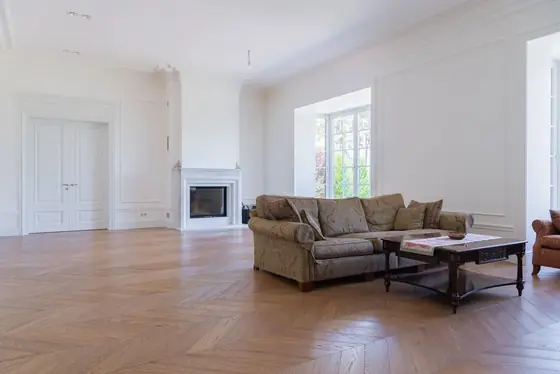
Floor sanding in Melbourn's period homes
Lift a corner of carpet in an older house and you'll often find pine boards, darker round the edges where an old rug once sat. Chris sands them with a belt sander, reaches the edges with an edging sander and fills gaps with the floor's own sawdust mixed with Induro Morrells Mix & Fill.
The interwar years added only about 100 homes, and most of the village is post-war, so many floors here will be newer timber, engineered boards or laminate. Chris checks before quoting: engineered boards may take a light sand or none, and laminate can't be sanded.
Choosing a finish
We finish in Osmo Polyx hardwax oil. Clear keeps the boards close to their freshly sanded colour, and tinted versions change it, like the Gold tint with 24-carat gold flecks on a floor in Haddenham. Worn patches can be re-oiled later without sanding the room.
Melbourn at a glance
- 19 milesby road from our Landbeach base, about 27 minutesOSRM routing
- 12%of properties were built before 1919VOA Council Tax stock
- 4%date from 1919 to 1939VOA Council Tax stock
- 17%are terracedCensus 2021
- 72listed buildingsHistoric England
- 2,143householdsCensus 2021
How we approach floor sanding
Before sanding, Chris secures loose boards and sinks protruding nails so they don't tear the paper. He works through coarse to fine grades, fills gaps, smooths with a Mirka dust-free sander and applies thin coats of oil. If we're decorating too, the floor comes last and any scuffed skirtings are touched in afterwards. The full method, products and FAQs are on our floor sanding page.