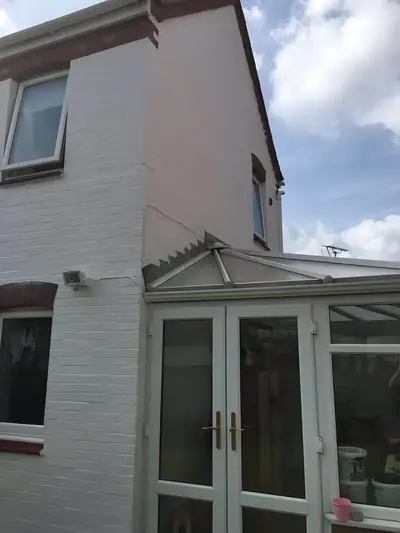
House painting in Melbourn
Graham starts by walking round the outside, looking for blown render, cracked masonry, soft timber and failed putty. Repairs go into the written quotation, and our master builder and carpenter take on anything beyond filling.
North-facing and shaded walls often carry algae. We jet wash those with an anti-fungal solution, let them dry thoroughly and only then paint, using breathable masonry paint so moisture in the wall can escape.
Colours in Melbourn's conservation area
Melbourn has a conservation area, and 72 of its buildings are listed, including 10 and 12 Mortlock Street at Grade II. A test patch on a discreet wall shows how a shade really looks in daylight.
Newer houses, about a quarter of the village, tend to need fascias, soffits, doors and window timber refreshed first as the original finish weathers. Fences and sheds can follow; see garden timber painting in Melbourn.
Exterior painting in Melbourn: three or four sides to most houses
Of the 2,140 Melbourn homes counted at the 2021 Census, 1,635 were detached or semi-detached, and 801 of those stood fully on their own. So an outside job here usually means three or four elevations facing different ways: a shaded north wall green with algae can sit round the corner from a sunny front where the paint has dried out and cracked.
That's why Graham walks right round the house before quoting and notes what each side needs: an anti-fungal wash on the shaded walls, scraping and filling on the weathered ones, and our carpenter for any sill or fascia that has gone soft. Our exterior restoration case study shows the anti-fungal treatment on a Cambridge house with mould and flaking paint.
Where the house stands matters as well. Melbourn has one conservation area, and the council lists an appraisal for it, the Melbourn Conservation Area Appraisal 2021, although it says only 22 of its 85 conservation areas have one. Historic England's list adds 72 entries in the parish. If your house is on the list or inside the conservation area, the colour question starts with the council, as the note below explains.
Figures from 2021 Census (ONS); Met Office 1991-2020 climate averages; Historic England's National Heritage List; Historic England conservation areas. Source: Office for National Statistics licensed under the Open Government Licence v.3.0. Contains public sector information licensed under the Open Government Licence v3.0. © Crown Copyright 2026. Contains Ordnance Survey data © Crown copyright and database right 2026. Released under OGL. © Historic England and Local Planning Authorities 2026.
Melbourn at a glance
- 14 milesfrom our Landbeach base in a straight line, about 27 minutes by roadOSRM routing
- 93%are houses rather than flatsCensus 2021
- 37%of homes are detachedCensus 2021
- 12%of properties were built before 1919 (Melbourn and the surrounding area)VOA Council Tax stock
- 1conservation areaHistoric England
- 14%were built 1945 to 1964 (Melbourn and the surrounding area)VOA Council Tax stock
Sources: Census 2021 for Melbourn parish (ONS); Council Tax: stock of properties, 2026, for the statistical areas covering Melbourn and the surrounding area; Historic England conservation areas; road distance by OSRM.
Listed buildings and conservation areas in Melbourn
- The Manor HouseGrade II* listed
- Parish Church of All SaintsGrade II* listed
- 10, 12, Mortlock StreetGrade II listed
- MelbournConservation area
Sources: Historic England listed buildings; Historic England conservation areas.
Planning: check before you change colours
Check two things before choosing a new outside colour: whether your house is one of the parish's 72 list entries, and whether it lies inside the Melbourn conservation area. For a listed house, South Cambridgeshire District Council's listed buildings page says listed building consent is required for any work that affects the character of the building; for one in a conservation area, its conservation areas page says you may need planning permission for some works that would otherwise not need it. When we checked the council's Article 4 register in October 2026, Melbourn wasn't among the places it names, but the register doesn't say it is complete, so ask about your own address as well.
Melbourn Conservation Area Appraisal 2021 (PDF) · Conservation areas, Greater Cambridge Shared Planning · Listed buildings and listed building consent · Local planning restrictions, including Article 4
How we approach exterior painting
For a detached or semi-detached Melbourn house, the elevations are taken in an agreed order so ladders and towers go round the house once. Shaded walls are jet washed with an anti-fungal solution and left to dry, loose paint is scraped and sanded back, cracks in render and brick are filled with exterior filler, and bare timber is primed. The walls get a breathable masonry paint in the coats the product needs, and fascias, soffits, gutters and downpipes are finished from the same access. How we work, step by step, and the questions people usually ask are on our exterior painting page.
Best time of year for the work
On the 1991-2020 averages for the Met Office's Cambridge NIAB station, about 12 miles north of Melbourn, March and February are the driest months, but they're also frosty there, averaging about 5 days of air frost in March and about 9 days in February. June to September is the stretch with no air frost at all, and even then August is the second-wettest month, at about 56 mm, so outside painting goes in the diary for late spring to early autumn, with the days themselves chosen from the forecast.