
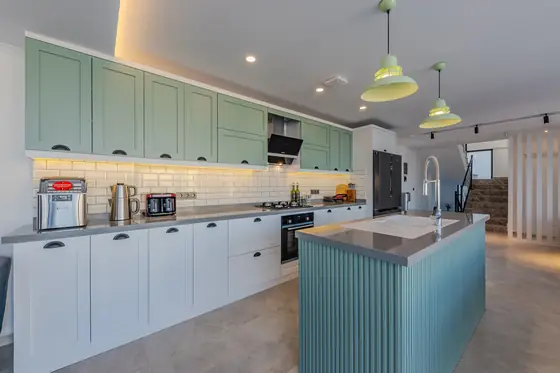
Fitted kitchens from the 1980s and 1990s
Kitchens from that era were often built with sturdy carcasses and painted timber, MDF or foil-wrapped doors. Timber and MDF take paint well. Some shiny wrapped finishes don't, and Graham will tell you at the visit if yours is one of them rather than quoting for something unlikely to last.
With 28% of households here paying a mortgage and almost 40% owning outright, many kitchen enquiries come from people who've decided the layout works and the money is better spent elsewhere. Repainting keeps the worktops, plumbing and appliances exactly where they are.
Spray or brush in a family kitchen
Larger kitchens with flat slab doors suit our Graco Ultra cordless sprayer, which leaves no brush marks. Shaker doors in a smaller room are often better done by hand. Either way, day one is degreasing and sanding with Mirka dust-free sanders, followed by a Zinsser primer chosen for the surface.
Timber worktops can be sanded and oiled with Osmo, as we did at the Old Telephone Exchange in Fulbourn. Our main cabinet painting page covers the process in more depth.
Histon & Impington at a glance
- 5 milesby road from our Landbeach base, about 10 minutesOSRM routing
- 68%of homes are owner-occupiedCensus 2021
- 28%of households own with a mortgageCensus 2021
- 21%were built 1983 to 1999VOA Council Tax stock
- 16%were built since 2000VOA Council Tax stock
- 90%are houses rather than flatsCensus 2021
How we approach kitchen cabinet painting
Doors and drawer fronts are labelled and taken off where that helps, then degreased, sanded and primed. Carcass fronts and end panels are masked and done in place. We finish in a hard-wearing eggshell or satin such as Tikkurila, and plan the order of work so you keep the sink and fridge throughout. The full method, products and FAQs are on our kitchen cabinet painting page.