
Victorian and interwar walls in Great Shelford
Council Tax records show roughly 320 homes in the parish from before 1919 and about 330 from the interwar years. The village drew Cambridge academics in Victorian times, and plaster from that era has usually been patched more than once, and stripping old paper can bring loose areas away.
Where a wall is cracked or uneven, we hang lining paper first so the finish paper dries flat and the joins stay tight. If stripping reveals plaster that needs more than lining, our own plasterers can skim it without stalling the job.
Heritage papers for owner-occupied homes
About 64% of Great Shelford households own their home, and owners in older houses often choose heritage or designer papers. Those can be expensive and hand-printed, so Simon, our wallpaper specialist, checks batch numbers, plans where the pattern falls on each wall and works out the least visible join before cutting. His work on a three-storey William Morris staircase in Cambridge is a good example.
The parish has 34 listed buildings, from the Grade I Church of St Mary to the Grade II* Rectory Farmhouse. If your home is listed, talk to South Cambridgeshire District Council before stripping anything historic.
Great Shelford at a glance
- 14 milesby road from our Landbeach base, about 21 minutesOSRM routing
- 14%of properties were built before 1919VOA Council Tax stock
- 14%date from 1919 to 1939VOA Council Tax stock
- 2,030householdsCensus 2021
- 34listed buildingsHistoric England
- 64%of homes are owner-occupiedCensus 2021
How we approach wallpapering
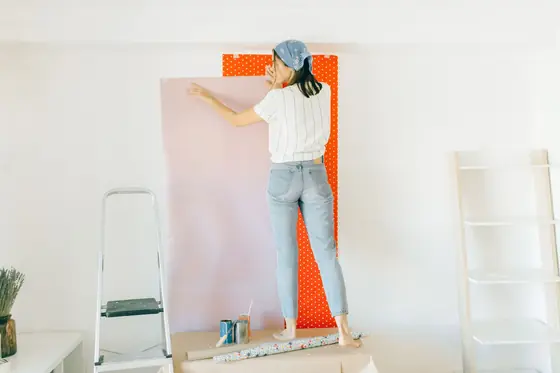
For an older Great Shelford room we strip existing paper, wash off old paste and test the plaster for loose patches. Cracks are filled, the wall is sized where the manufacturer recommends it, and lining paper goes on any uneven surface. The pattern is set out from a plumb line, with the main motif centred on the chimney breast or focal wall. The full method, products and FAQs are on our wallpapering page.