Post-war Artex ceilings in Great Shelford
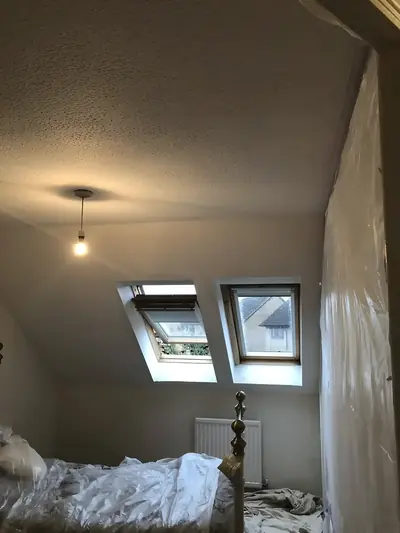
Roughly 44% of the parish's homes date from 1945 to 1982. Many of their ceilings have been textured at some point, and skimming over the Artex gives a smooth surface ready for paint, without the mess of taking the ceiling down. Lewis, our plasterer, or the master plasterer we work with, does the skimming once the room is sheeted and fittings are down.
If you're not sure what your textured coating contains, get it tested before anyone scrapes or sands it. Our Artex skimming case study shows a finished ceiling.
Lath and plaster in the older village
Around 320 homes predate 1919. Their walls and ceilings may be lath and plaster, often patched over the years, and stripping old paper can show how tired it is. Sometimes a skim is right; sometimes lining paper and careful filling is enough. Graham decides which at the survey so you don't pay for more plastering than the room needs.
Plaster and decoration go into one quotation, and our interior decorating team picks the room up as soon as the plaster is dry.
A late post-war building boom, and the ceilings it left in Great Shelford
Post-war building in Great Shelford came late. Council Tax records put only about 70 properties in the 1945 to 1954 band, then roughly eight times as many from 1955 to 1964, and building carried on through the 1960s and 1970s. Textured coatings such as Artex were common on ceilings in houses of that era, and they're often why a room of that age needs a plasterer before a decorator. How Lewis deals with them is set out on our Artex removal and skimming page.
A Checkatrade review from a job in the CB22 postcode district, which includes Great Shelford and nearby villages such as Sawston, describes exactly this kind of work: a cracked ceiling re-skimmed to cover Artex, with numerous wall cracks cut out and filled and the decoration made good. The customer's verdict, in January 2020, was “Very quick and neat work. Very professional. Time-keeping was perfect.”
Older plaster needs a lighter touch. In the village's Victorian and earlier houses, walls are often soft lime plaster, sometimes on laths, which is better kept and lined where it's sound than stripped back; where it has blown or crumbled, our plasterers make it good before anything is painted.
Figures from Valuation Office Agency Council Tax stock by build period. Contains public sector information licensed under the Open Government Licence v3.0.
Great Shelford at a glance
- 8 milesfrom our Landbeach base in a straight line, about 21 minutes by roadOSRM routing
- 27%were built 1945 to 1964VOA Council Tax stock
- 17%were built 1965 to 1982VOA Council Tax stock
- 14%of properties were built before 1919VOA Council Tax stock
- 2,030householdsCensus 2021
- 14%date from 1919 to 1939VOA Council Tax stock
Sources: Census 2021 for Great Shelford parish (ONS); Council Tax: stock of properties, 2026; road distance by OSRM.
Listed buildings: check before plastering
If your Great Shelford house is listed, ask South Cambridgeshire District Council before any original plaster is stripped or replaced. Its listed buildings page says listed building consent “is required for any work that affects the character of the building including alterations”, and adds that “it is a criminal offence to carry out unauthorised work to a listed building”. The council's Listed Buildings SPD and leaflet go into more detail.
Listed buildings, Greater Cambridge Shared Planning · Listed Buildings SPD (PDF) · Listed buildings leaflet (PDF)
How we approach plastering
In a Great Shelford house from 1955 to 1964, we start by sheeting the room and taking down light fittings and smoke alarms, then check the textured ceiling for cracks and loose areas. The surface is prepared so the new plaster bonds, and Lewis or our master plasterer skims over the Artex. Once it has dried right through, our decorators sand it lightly with Mirka dust-free sanders and apply a mist coat of thinned emulsion, which shows up any dips to fill before the two finish coats. Each step and the products we use are explained on our plastering page, with answers to common questions.
The Health and Safety Executive says textured coatings such as Artex in homes built or refurbished before 2000 may contain asbestos, so a sample should be tested before anyone sands, scrapes or drills it. If asbestos is found, work that disturbs it is a job for an asbestos specialist: we don't remove asbestos. Our Artex skimming page and guide to plastering over Artex set out the safe order of work.