
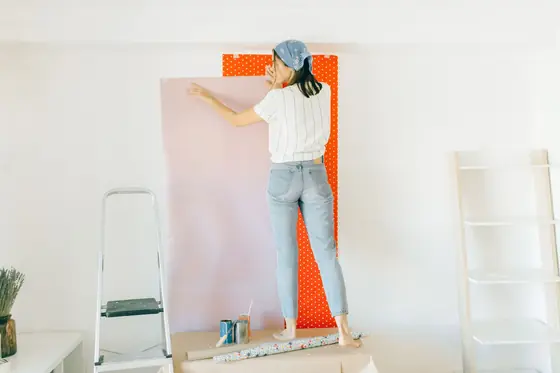
Feature walls in Sawston's post-war houses
Council Tax records put the median Sawston home in the 1965 to 1972 build period. Plasterwork from those years tends to be fairly even, and a single papered wall behind a bed or across a chimney breast is a quick way to give a room a focus.
Owner-occupiers make up about two thirds of the village, and they are the people most likely to choose a heritage or designer paper. Those can be expensive, so we check batch numbers, plan where the pattern falls and work out the least visible join before cutting anything.
Older and listed walls
About 210 Sawston homes predate 1919, and the village has 45 listed buildings. Older walls are often patched or uneven, and lining paper gives the finish paper a consistent surface to dry onto. If stripping reveals loose plaster, our plasterers can skim it before we hang.
For listed homes, check with the district council before removing any historic paper. Simon, our wallpaper specialist, has protected an old William Morris paper while work went on around it.
Sawston at a glance
- 16 milesby road from our Landbeach base, about 24 minutesOSRM routing
- 7%of properties were built before 1919VOA Council Tax stock
- 4%date from 1919 to 1939VOA Council Tax stock
- 3,057householdsCensus 2021
- 45listed buildingsHistoric England
- 66%of homes are owner-occupiedCensus 2021
How we approach wallpapering
We strip old layers, wash off paste and fill cracks. Patched or older walls are lined and left to dry. We hold samples up in the room so you can judge the pattern scale, set out the repeat from the wall you see first and hang each drop to a plumb line. The full method, products and FAQs are on our wallpapering page.