
Post-war woodwork, done properly
Over 1,100 homes in the village were built between 1965 and 1982, according to Council Tax records. In houses of that age, old gloss is often yellowed, chipped and too shiny for a new coat to grip. We clean, sand and fill before anything goes on.
Many people now switch from gloss to satin or eggshell, which has a softer sheen and shows fewer dents. Painting skirtings and doors in the wall colour, or one shade darker, makes a three-bedroom semi feel calmer.
Natural timber in older homes
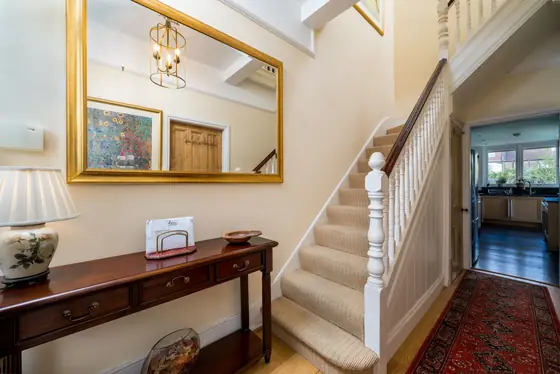
Sawston's handful of period homes and its 45 listed buildings have more panelled doors, deeper skirtings and older staircases. Natural timber like this can be stained, varnished or oiled. Treads and handrails are sanded evenly so the stain takes without blotching, then protected with a clear coat.
For listed homes, check before stripping any historic finish. Our Fulbourn staining page shows the oiled beams we finished nearby.
Sawston at a glance
- 16 milesby road from our Landbeach base, about 24 minutesOSRM routing
- 7%of properties were built before 1919VOA Council Tax stock
- 4%date from 1919 to 1939VOA Council Tax stock
- 93%are houses rather than flatsCensus 2021
- 45listed buildingsHistoric England
- 66%of homes are owner-occupiedCensus 2021
How we approach woodwork staining & varnishing
Every surface is cleaned and lightly sanded, gaps where skirtings meet the wall are filled, and old drips are rubbed out. Before staining we test the colour on a hidden spot, such as the back of a door. Bare pine is sealed with Zinsser so knots do not bleed through. The full method, products and FAQs are on our woodwork staining & varnishing page.