Feature wall wallpaper, hung by our wallpaper team
A feature wall is one wall papered while the rest of the room is painted. We hang feature wall wallpaper, photo murals and panel designs in bedrooms, living rooms, hallways and offices in and around Cambridge. Our wallpaper specialist Simon and the decorators who hang paper with him handle the job from preparing the wall to trimming the last edge.
Because there's only one wall, every flaw is on show. The pattern has to sit centrally, the edges at the corners and ceiling have to be crisp, and a mural has to read as one picture rather than a set of strips. That comes down to setting out, which is where most of our time on a single wall goes.
Setting out a single wall
Before any paste is mixed, the wallpaper installer works out where each drop will fall. The usual approach on a feature wall is to start from the centre line, either with a join on the centre or with the middle of a drop on it, whichever leaves the most even cuts at both corners. Starting at one corner and working across tends to leave a thin sliver at the far end, which looks like an afterthought.
The same thinking applies to the height. On a bold repeat we decide where the motif sits against the ceiling line, so a full flower or shape is near the top rather than cut in half where the eye lands first. A chimney breast is treated as its own small wall, centred on itself.
Each length is hung to a plumb line, not to the corner of the room, which in older Cambridge houses is rarely straight. Any lean in the corner is taken up in the final cut where it's least visible.
Photo murals and wallpaper mural installation
A photo mural arrives as a set of numbered panels that build one image. Mural wallpaper installation leaves no room for drift: if the first panel is a few millimetres out, the horizon, tree line or skyline steps at every join.
We open the set first and lay the panels out in order on a clean floor to check none are missing, the print colour matches across the set and the overall size suits the wall. Murals are often made slightly larger than the wall so there's something to trim at the edges, but a mural ordered too small can't be fixed on site. If anything looks wrong, it goes back to the supplier before a drop of paste touches it.
Most modern murals are printed on non-woven material and hung by pasting the wall, which keeps the panels dimensionally stable. Panels are butted rather than overlapped, and we smooth from the centre outwards so air and excess paste don't push the image out of line.
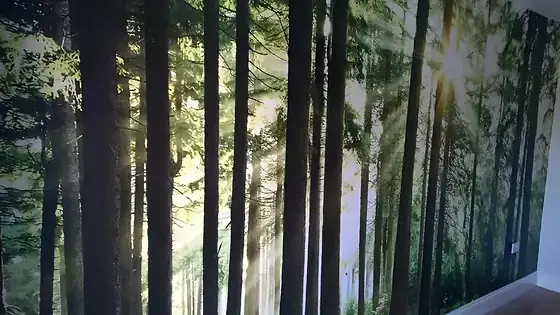
One Checkatrade customer who had several unusual papers hung by Jack wrote: "I didn't think it could be possible but he put up photo mural wallpaper by himself and it was perfect." Our project gallery includes a sunlit forest mural covering a whole wall, which shows how much of a room a single image can carry.
Panels, brick effect and textured feature papers
Not every feature wall is a picture. Brick and stone-effect papers, large geometric repeats and grasscloth all work as single walls, and each has its own catch.
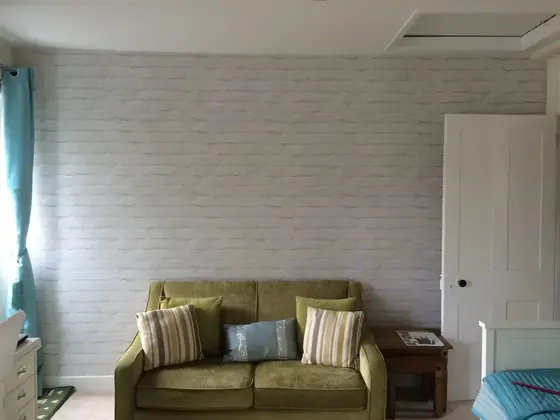
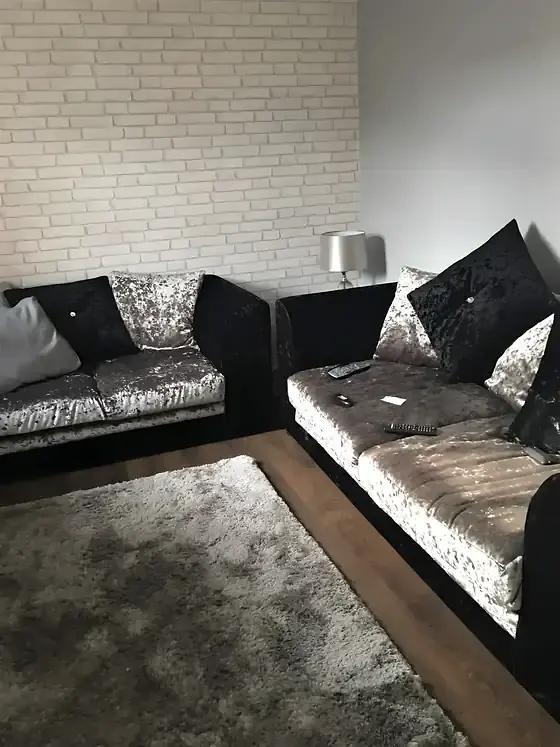
Brick effect has to be set out so the courses run level and the joins disappear into the mortar lines. In a listed studio flat in central Cambridge, Simon hung a white brick-effect feature wall after the rest of the room had been stain-blocked and repainted, which you can see in the studio flat case study.
Grasscloth wallpaper installation needs a different mindset. It's a natural material, so colour varies from drop to drop and the joins always show to some degree. Paste must stay off the face, and a good fitter will arrange the drops so the shading changes gently across the wall rather than in stripes.
Getting the wall ready
A feature wall shows its surface more than a painted one, especially under a light that skims across it. Old paper comes off first (our wallpaper removal page explains how), then we fill, sand and prime so the paste dries evenly. Uneven plaster may need lining first, and sockets and switches are loosened so the paper tucks neatly behind the faceplates.
Choosing which wall to paper
Graham will give an honest view during the visit. A wall with few doors, windows and sockets suits a large pattern or mural best. The wall facing you as you walk in usually has the most impact, and the wall behind a bed or sofa is a common choice because it frames the furniture. Holding a sample up in the room, in daylight and lamplight, helps judge the scale.
What affects the price of a feature wall
All of this is set out in the written quotation, so the cost of preparing the wall is clear before work starts.
- The size of the wall and the number of drops or panels
- Doors, windows, sockets, radiators or a chimney breast to cut around
- The paper: standard repeat, large repeat, mural, grasscloth or brick effect
- How much stripping, filling or lining the wall needs first
- Height and access, for example on a stairwell
- Whether the rest of the room is being painted at the same time
From visit to finished wall
Graham looks at the wall, checks how much paper or how many panels you have, and tells you if anything is missing. You get a written quotation, usually by email. On the day, we protect the floor, prepare and hang, and leave the room tidy. We'll walk you round the finished wall, and you don't pay until you're happy with it. For the wider range of papers we hang, see our main wallpapering service.