
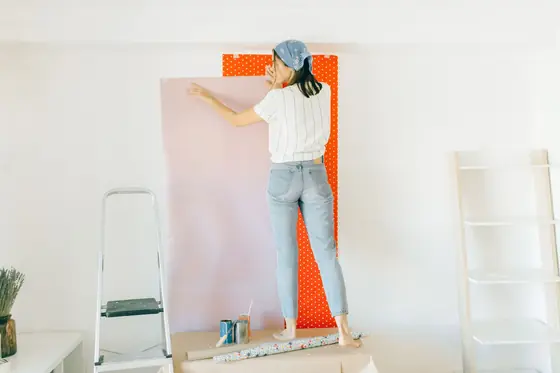
Papering modern walls properly
Newer walls are flatter than Victorian ones, which helps, but they bring their own issues. Bare or barely painted plasterboard can be very absorbent and can tear when paper is later stripped, so we size or prime it as the paper manufacturer recommends before the first length goes up.
Simon, our wallpaper specialist, plans where the pattern will fall on each wall, checks the batch numbers and works from a true vertical. That matters most in open-plan living spaces, where one long wall is seen from every angle.
Where paper works in a Cambourne house
More than a third of households here have four or more bedrooms, so there is room for a bolder paper on a stairwell, a dining wall or behind a bed. Children's rooms are a common request too, including photo murals, which need panels set out carefully before any paste goes on.
With 59% of homes owner-occupied, many people want a paper that will last them years. Our wallpaper hanging service page explains how we deal with designer and heritage papers when there is little margin for waste.
Cambourne at a glance
- 13 milesby road from our Landbeach base, about 16 minutesOSRM routing
- 3%of properties were built before 1919VOA Council Tax stock
- 1%date from 1919 to 1939VOA Council Tax stock
- 4,364householdsCensus 2021
- 2listed buildingsHistoric England
- 59%of homes are owner-occupiedCensus 2021
How we approach wallpapering
On a Cambourne wall we check the plasterboard for popped screw heads and fill them flush, then size or prime the surface so the paper can be repositioned while hanging. Heavy papers are hung over lining paper where the wall needs it, and every drop is checked with a plumb line. The full method, products and FAQs are on our wallpapering page.